BitcoinWorld What Happens If You Send USDT on the Wrong Network (ERC-20 vs TRC-20 vs BEP-20)? What Happens If You Send USDT on the Wrong Network (ERC-20 vs TRC-20 vs BEP-20)? Sending USDT on
BitcoinWorld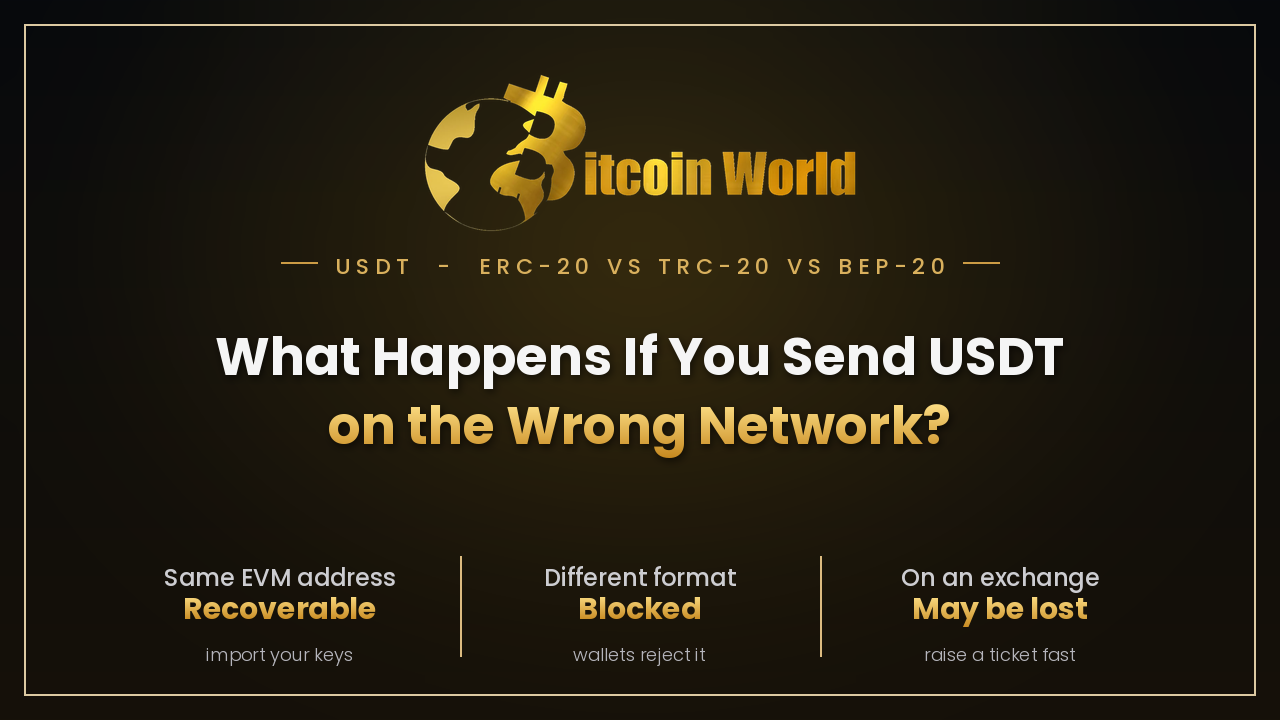 What Happens If You Send USDT on the Wrong Network (ERC-20 vs TRC-20 vs BEP-20)?
What Happens If You Send USDT on the Wrong Network (ERC-20 vs TRC-20 vs BEP-20)?
Sending USDT on the wrong network is one of the most expensive beginner mistakes in crypto, and it’s incredibly common because the same USDT exists on several different blockchains at once. The same ticker on Ethereum (ERC-20), Tron (TRC-20), and BNB Chain (BEP-20) behaves completely differently when it comes to where your money lands. This article explains what actually happens during a network mismatch, when your funds are recoverable, when they’re gone, and how Indian users – who lean heavily on cheap TRC-20 transfers – can stay safe.
What Happens If You Send USDT on the Wrong Network?
When you send USDT on the wrong network, the tokens travel on a blockchain different from the one the receiver expects, and whether you can recover them depends on the address format and who controls the destination.
- Same asset, many chains: USDT exists as ERC-20 (Ethereum), TRC-20 (Tron), BEP-20 (BNB Chain), plus Solana and others – identical ticker, different rails.
- EVM chains share an address format: Ethereum, BNB Chain, and Polygon all use 0x… addresses, so funds can land on the “wrong” one but the right address.
- Tron is different:TRC-20 addresses start with T, a completely different format from 0x addresses.
- The outcome hinges on control: If you hold the private keys, recovery is often possible; if it’s an exchange that doesn’t support that network, it may not be.
When Is USDT Sent on the Wrong Network Recoverable?
The good news is that many wrong-network sends are recoverable, especially if you control your own wallet.
- Wrong EVM chain, your own wallet: If you sent BEP-20 USDT to an address you intended for ERC-20, the funds sit at that same 0x address on BNB Chain – just import your seed phrase/private key into a wallet that supports BNB Chain to access them.
- Format mismatch is blocked: You generally cannot send TRC-20 USDT to a 0x address – wallets reject the mismatched format, which actually prevents many disasters.
- Self-custody is your friend: Holding your own keys means a wrong EVM network is an inconvenience, not a loss.
- Always confirm chain support: Check that the destination wallet supports the exact network before sending.
When Is Wrong-Network USDT Actually Lost?
The most dangerous scenario involves sending to an exchange deposit address on a network it doesn’t credit.
- Unsupported exchange network: If you deposit BEP-20 USDT to an exchange address that only credits ERC-20, the platform may not automatically see it.
- Recovery is case-by-case: Some exchanges recover EVM-chain funds (often charging a fee); others cannot or will not.
- Custodial limits: Because the exchange controls the keys, you can’t simply import them yourself.
- Best response: Raise a support ticket with the TXID, network, and amount immediately, but treat recovery as uncertain.
How Can Indian Users Avoid Sending USDT on the Wrong Network?
Indian users frequently use TRC-20 for its low fees in P2P trading, which makes network matching especially important.
- Match the network every time: Confirm both sides use the same chain – ERC-20 to ERC-20, TRC-20 to TRC-20, BEP-20 to BEP-20.
- Read the deposit screen: Indian exchanges clearly label the supported network on each deposit address; never assume.
- Send a small test: Transfer a tiny amount first, confirm it credits, then send the rest.
- Prefer the cheapest matching rail: TRC-20 often has low fees, but only use it if both wallets and exchanges support it.
Frequently Asked Questions
Can you recover USDT sent on the wrong network to your own wallet?
Often yes – if you control the private keys and sent USDT on the wrong EVM-compatible network like BEP-20 instead of ERC-20, the tokens sit at the same 0x address on that chain. You can import your seed phrase into a wallet that supports that network to access them. Recovery is much harder if you sent to an exchange that doesn’t credit the network you used.
What happens if you send TRC-20 USDT to an ERC-20 address?
In most cases the transfer is blocked, because TRC-20 addresses (starting with T) and ERC-20 addresses (starting with 0x) use entirely different formats that wallets won’t let you mix. This format difference actually protects users from one of the worst mistakes. The real risk lies between EVM networks like ERC-20 and BEP-20, which share the same address format.
Why do Indian users send USDT on the wrong network so often?
Indian users frequently switch between TRC-20 for cheap transfers and ERC-20 or BEP-20 on different platforms, making network mismatches easy. The fix is simple: always check the network label on the deposit screen, confirm both wallets support the same chain, and send a small test amount before the full transfer. This habit prevents nearly all wrong-network losses.
Conclusion: Why Network Awareness Is Non-Negotiable for USDT Holders
Understanding what happens when you send USDT on the wrong network can be the difference between a five-minute fix and a permanent loss, especially for Indian users juggling ERC-20, TRC-20, and BEP-20 across multiple platforms. The core lesson is that address format and key control decide everything: self-custody mistakes on EVM chains are usually recoverable, while wrong-network deposits to exchanges may not be. As USDT remains the backbone of crypto trading in India, making network-matching a reflex now will save you stress, money, and time for every transfer to come.
This post What Happens If You Send USDT on the Wrong Network (ERC-20 vs TRC-20 vs BEP-20)? first appeared on BitcoinWorld.