The Zcash price fell to around $860 on Monday, November 16, 2026. According to CoinGecko, ZEC was down 6.7 percent in 24 hours by Monday midday, close to Saturday evening's low of around $830
The Zcash price fell to around $860 on Monday, November 16, 2026. According to CoinGecko, ZEC was down 6.7 percent in 24 hours by Monday midday, close to Saturday evening's low of around $830. Based on CoinGecko's daily data, ZEC last traded lower in early September. On the same day, the polls opened in which Zcash holders and community panels vote until November 30 on the future of the developer fund Zcash Community Grants (ZCG). There is no evidence that the vote triggered the decline; the two events coincide in time.
The drop is markedly steeper than that of the broader market. Bitcoin and Ether each gave up around 2 percent over the same period. Since its high on September 27, Zcash has lost almost half its value.
Zcash price on November 16: down 6.7 percent in 24 hours
At midday on Monday, ZEC cost $860.66 according to CoinGecko, or 781.87 euros. The highest level of the past 24 hours was around $921 at midday on Sunday. Over seven days the loss is 28.7 percent, over 30 days 26.6 percent. With a market capitalisation of $14.7 billion, Zcash ranks 11th among the largest cryptocurrencies, and trading volume over the past 24 hours stands at $572 million.
The daily data show how quickly the descent came. On November 7, ZEC was still trading at around $1,322, and it has fallen on almost every day since. Measured against that level, the loss is around 35 percent in nine days. On Sunday the price briefly recovered: our article of November 15 described how Zcash clawed back 12 percent from its low ahead of the vote. That interim gain has since been given up, and the price is below Sunday morning's level.
Sentiment across the market remains subdued. The Fear and Greed Index from alternative.me stands at 10 points, in the "extreme fear" range. The index measures market sentiment on a scale of 0 to 100 and draws on price volatility, trading volume and search queries, among other inputs. Our market analysis explains how the broader market arrived at the crypto crash of recent days.
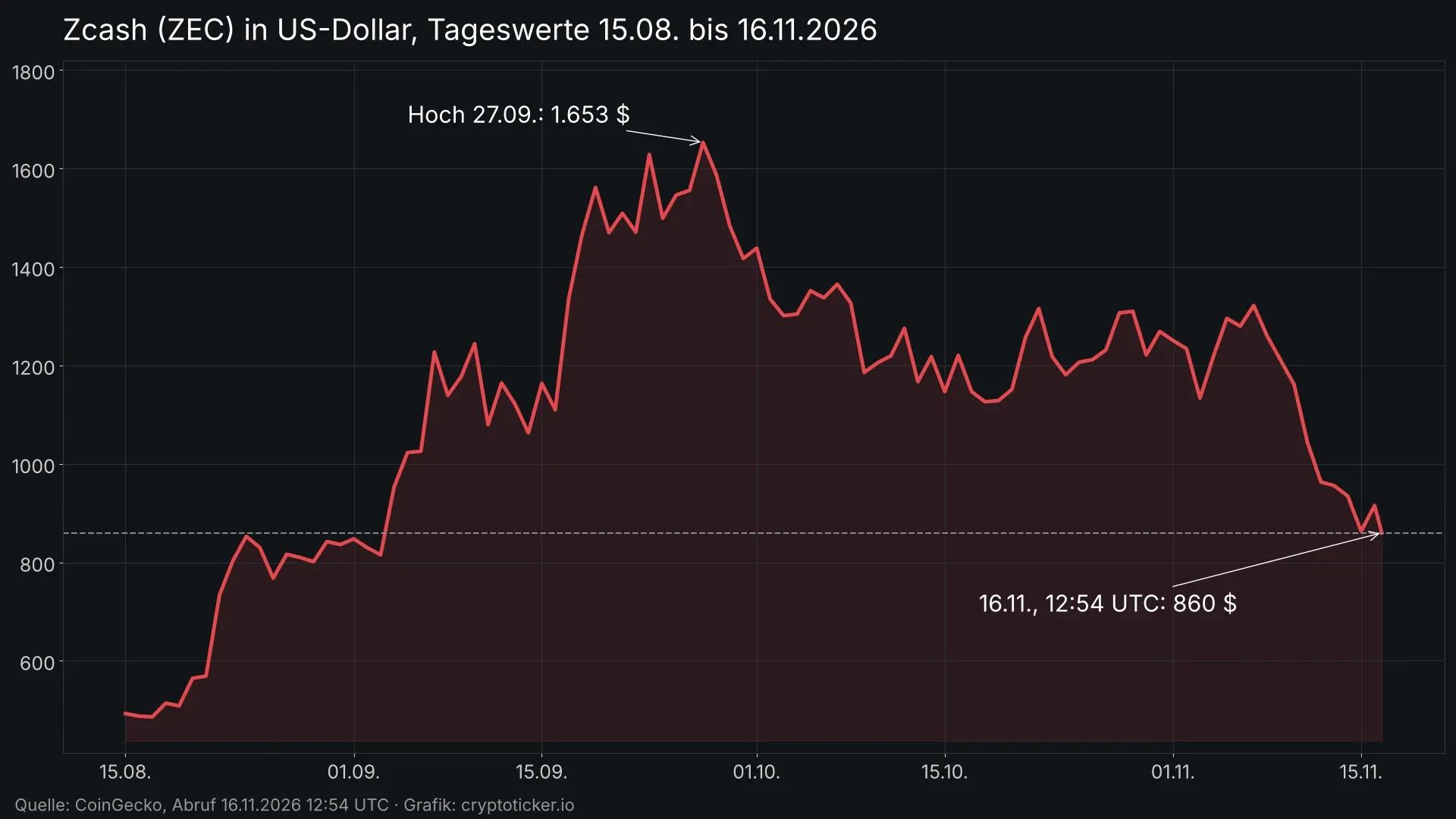
Zcash in US dollars since mid-August: almost half has been lost from the $1,653 high on September 27 (data: CoinGecko, own chart).
ZCG vote: what Zcash coinholders decide by November 30
Zcash Community Grants is a five-member committee that funds independent developers, wallet projects and community initiatives in the Zcash ecosystem. The fund is fed by a fixed share of newly created ZEC. How it should be resourced in future has been disputed for weeks.
The community published the timetable in the Zcash community forum. Proposals could be submitted until November 8, and questions and answer options were discussed from November 9 to 15. The polls for coinholders and community panels run from November 16 until Monday, November 30, 23:59 UTC. Results are due shortly afterwards. According to the forum, five organisations are coordinating the vote: Project Tachyon, Shielded Labs, Valar Group, Zcash Foundation and ZODL.
The vote is not binding. Once it closes, the organisers want to assess whether there is "rough consensus", meaning broad support for a change. Only then will developer teams and miners agree on a date for the NU7.1 network upgrade, which would have to implement any change to the fund technically. A network upgrade is a change to the protocol rules that all nodes on the network must adopt.
50,000 ZEC for the Network Sustainability Mechanism: the proposal in detail
At the centre is a draft Zcash Improvement Proposal (ZIP) written, according to CoinDesk, by Sean Bowe, Zooko Wilcox and Jason McGee. It provides for removing 50,000 ZEC from the ZCG treasury. That equals around 55 percent of the 91,453 ZEC shown in an October treasury statement. At today's price of $860, 50,000 ZEC are worth around $43 million.
The coins would go to the Network Sustainability Mechanism (NSM). The NSM is a reserve introduced with the NU7 upgrade that gradually pays ZEC back out to miners through future block rewards. For holders, this means the coins do not disappear for good; they return to circulation spread over years, instead of being spent at short notice through grants.
The second part of the draft: the 8 percent share of newly created ZEC that ZCG receives today would flow into a new Future Dev and Legal Defense Fund until the next halving. Initially nobody could spend anything from this fund; that would require a further proposal. The separate Coinholder-Controlled Fund with 12 percent remains unchanged. According to the calculations in the draft, based on a ZEC price of $1,300 and spending in the first half of 2026, the ZCG treasury would currently last for about 13 years, and for around six years after the withdrawal. At the current price of $860 the runway is correspondingly shorter.
Competing drafts: ZAP, dissolving ZCG and lock voting
The draft is not the only proposal. In replies in the timetable thread, participants name further candidates: a proposal to wind up ZCG entirely and give its funds to the NSM, a Zcash Adoption Pool (ZAP), and a draft for coinholder polling in which votes are weighted by how long the coins are locked. One participant also explicitly called for the option of leaving the existing rules under ZIP 1016 unchanged.
This followed a climbdown: on November 3, ZCG dropped its own plan to redirect around 98,000 ZEC gradually to future mining rewards after criticism of its scale. We traced the path there in our explainer on the Zcash vote on 50,000 ZEC of November 12. Which options will finally be on the ballot, and exactly how the cut-off date and participation are regulated, is not clear from the timetable thread. If you want to vote, check the conditions in the organisers' official announcements.
Zcash vs the broader market: bitcoin and Ether lose only around 2 percent
Among the 25 largest cryptocurrencies by market capitalisation, Zcash was one of the weakest on Monday midday. According to CoinGecko, bitcoin lost 2.1 percent to $64,116 and Ether 2.0 percent to $1,796. Solana gave up 2.9 percent, Cardano 3.4 percent and Hyperliquid 4.4 percent. Among the large coins, only Zcash fell by more than 5 percent.
On a weekly view the gap is similar: bitcoin lost 13.0 percent in seven days and Ether 14.2 percent, against 28.7 percent for Zcash. The coin had previously outperformed the market. Between mid-August and the end of September, ZEC climbed from below $500 to more than $1,600. Part of that lead is now being unwound.
There is no single, documented cause for Monday's decline. Three factors are known to coincide: the weak overall mood with a Fear and Greed Index of 10, the open dispute over the developer fund and the start of the vote itself. How strongly each factor weighs cannot be read from price data alone.
Will Zcash fall below $800? The levels since the September high
The next level to the downside is around $830. ZEC fell that far on Saturday evening, November 14, according to CoinGecko's hourly data, before the recovery to $921 set in. Below that comes the round $800 mark. At the end of August and in early September the price moved between $770 and $850 for several days, and on August 26 the daily value was $768. That range was the starting point for the climb towards $1,600 at the time.
To the upside, Sunday's daily high of around $921 is the first level, followed by $1,000. Zcash fell below that threshold between November 10 and 12. Whether a level holds is decided by trading, and the number alone settles nothing. Price zones where many buyers or sellers were active in the past are called support and resistance in trading.
Two scenarios can be described with conditions. If ZEC holds the zone around $830 and a clear majority emerges in the vote, the market removes one uncertainty from the price. If the price falls below $800, the late-August range around $770 comes into view as the next zone. Neither scenario is a forecast; you can find the longer-horizon Zcash price prediction on our prediction page.

Zcash coinholders vote until November 30 on how the developer fund is resourced, while the price remains under pressure.
Leverage and liquidation on ZEC: what 10x and 20x mean on a day like this
Many investors trade sharp moves with leveraged products, meaning futures, perpetuals or CFDs. Leverage multiplies the effect of a price move on the capital employed, in both directions. Liquidation is the moment when the exchange forcibly closes a leveraged position because the posted collateral no longer covers the loss.
A simplified example without fees, funding costs or maintenance margin: anyone who went long with 10x leverage at $920 on Sunday had lost around 65 percent of their stake at $860; liquidation would come at a 10 percent price drop, around $828. With 20x leverage, 5 percent is enough; liquidation would be at around $874 and would have been reached on Monday. At 100x leverage, a counter-move of around 1 percent suffices. Conversely, a 10x short position would have gained around 65 percent over the same period.
Anyone trading with leverage therefore sets a stop-loss before entering, an automatic sell order at a fixed price, and limits position size so that a single loss does not endanger the account. Which providers offer leveraged products on cryptocurrencies, and at what cost, is shown in our comparison of crypto brokers. CFDs are complex instruments and come with a high risk of losing money rapidly due to leverage; most retail investor accounts lose money when trading CFDs.
Buying Zcash in Germany: the exchange's MiCA licence is what counts
If you want to buy or sell ZEC without leverage, you need a trading venue that lists Zcash. That cannot be taken for granted: as a privacy coin with optionally encrypted transactions, Zcash is not offered by every exchange. Since the end of the transition period of the EU's MiCA regulation (Markets in Crypto-Assets), providers serving customers in Germany need authorisation as a crypto-asset service provider. Which platforms hold this authorisation is listed in our comparison of regulated crypto exchanges.
Fees and spreads differ markedly, especially on volatile days. The spread is the difference between the buy and sell price, and it is often higher for less-traded coins than for bitcoin. Our comparison of the best crypto exchanges gives an overview of costs and offerings. Placing buy orders in tranches rather than all at once spreads the risk of a poorly timed entry.
Zcash after the vote opens: $830 and $1,000 as the boundaries
Until November 30, the vote on the ZCG fund remains the key date for Zcash. Two levels can be read off the price: Saturday's low around $830 and the $1,000 threshold that ZEC lost a week ago. Three steps help put the situation in context:
- Check your trading venue: Find out whether your exchange holds a MiCA licence and lists ZEC. The comparison of regulated crypto exchanges shows the current status.
- Compare costs: On days with strong moves, watch spreads and order fees. The exchange comparison shows the differences.
- Limit leverage: If you trade with leverage, calculate the liquidation price beforehand and set a stop-loss. Providers and terms are listed in the broker comparison.
(As of November 16, 2026. This article is not investment advice. Prices and fee structures change; check the terms with the provider before you buy.)