



13,000 Banks, $12.5 Trillion: What Ripple’s Latest Figures Mean for XRP
 PAT
PAT
 UTED
UTED
 SEC
SEC
 $L
XRP
$L
XRP
- Ripple says its treasury platform links 13,000 banks and handles $12.5T in payment volume across its wider system.
- XRP trades near $1.41 after breaking $1.40, with traders watching descending resistance and rising support.
Ripple’s latest treasury update has brought fresh attention to XRP after the company pointed to the scale of its financial network. The company said Ripple Treasury offers full cash visibility, access to 13,000 connected banks, and $12.5 trillion in payment volume moving through its system.
The figures come after Ripple acquired GTreasury in 2025 for $1 billion, a deal that expanded its reach across corporate treasury operations and banking infrastructure. The update has drawn attention from XRP supporters, who now see Ripple’s treasury network as a larger part of the token’s long-term utility debate.
The main question remains how much of that payment flow uses XRP directly. Ripple’s broader enterprise systems can support payments and treasury services without processing every transaction through the token. That distinction keeps the latest figures important, but still separate from direct XRP demand.
Market participants have connected the 13,000-bank figure to an earlier debate from the SEC v. Ripple case. Court records showed that Ripple had signed about 1,700 non-disclosure agreements with different entities. Some XRP holders linked those agreements to possible banking relationships at the time.
Ripple’s latest update gives the discussion a more concrete base, although it does not confirm that all connected banks use XRP. It shows that Ripple has built a wide financial network through treasury and payment services. However, token utility still depends on actual settlement usage, liquidity demand, and institutional adoption.
XRP Utility Debate Turns to Real Usage
Veteran investor Patrick L. Riley said the figures show that Ripple has reached a broad base of financial institutions. He also compared the 13,000-bank figure with the number of banks and credit unions in the United States, placing Ripple’s network in a wider global context.
Riley then used a stock-to-flow-style model to estimate what XRP could be worth if 20 billion tokens supported $12.5 trillion in annual flows. His model pointed to a possible value of $625 per XRP. Nevertheless, that figure depends on assumptions that remain unconfirmed.
If you missed yesterday's $XRP announcement, this is what I was referring to.
Most people still don't get the significance, so allow me to elaborate:
During SEC v. Ripple Labs it surfaced that there were 1,700 NDA's between Ripple and other companies. A lot of people… https://t.co/L3eW1y6w7v
— Patrick L Riley (@Acquired_Savant) May 1, 2026
Such models assume that a large portion of Ripple-linked payment activity would involve XRP. At present, Ripple has not stated that the full $12.5 trillion runs through the token.
Meanwhile, Ripple executive David Schwartz has pushed back against claims of hidden XRP adoption plans. He said NDAs are common in business and do not prove the existence of secret market-moving events. His comments reduce speculation around undisclosed catalysts and keep attention on measurable adoption.
XRP’s current price action shows a separate market test. Technical charts show XRP trading near $1.41 after rallying 1% in 24 hours and breaking above the $1.40 area. A hold above that level could validate XRP’s move toward descending resistance, while failure could send the price back toward ascending support.
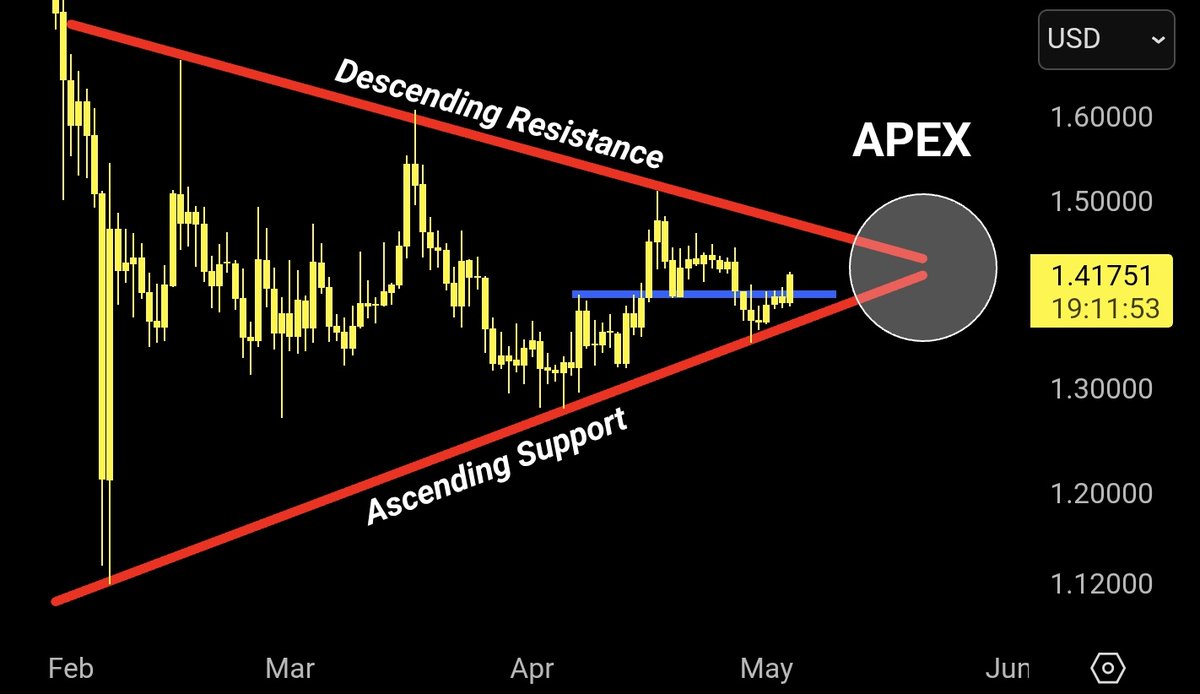
The chart shows XRP moving inside a tightening structure formed by descending resistance and rising support. Price has moved closer to the apex, where volatility often increases. The $1.40 area now acts as a short-term level to watch after the recent breakout attempt.
A sustained retest above $1.40 may keep buyers in control and allow XRP to challenge the descending resistance line near the upper side of the pattern.
The post 13,000 Banks, $12.5 Trillion: What Ripple’s Latest Figures Mean for XRP appeared first on ETHNews.
