



A dormant Ethereum whale awakens and shakes the markets
ETH
 ETH2.0
 DEFI
DEFI
 2.0
2.0
 READ
READ
An Ethereum wallet dormant since 2015 has just transferred $23 million worth of ETH. A harbinger of things to come? Between restructuring and speculation, Ethereum whales are on the move… But what are they really planning for the future of crypto?
En bref
- A whale from the 2015 ICO transferred 10,000 ETH ($23 million) after 11 years of inactivity.
- Analysts favor a custody restructuring rather than a massive ETH sale.
- No major impact on the crypto market, but a sign of maturity for Ethereum.
An Ethereum ICO whale wakes up after 11 years: $3,100 turned into $23 million
On April 28, 2026, an Ethereum whale inactive since 2015 finally stirred. Indeed, 10,000 ETH purchased at $0.31 during the ICO are now worth $23.125 million, a return of 7,500x. The transaction, validated on block 24981821, transferred almost all of the funds to a new address (`0x5C96F…`), triggering speculation.
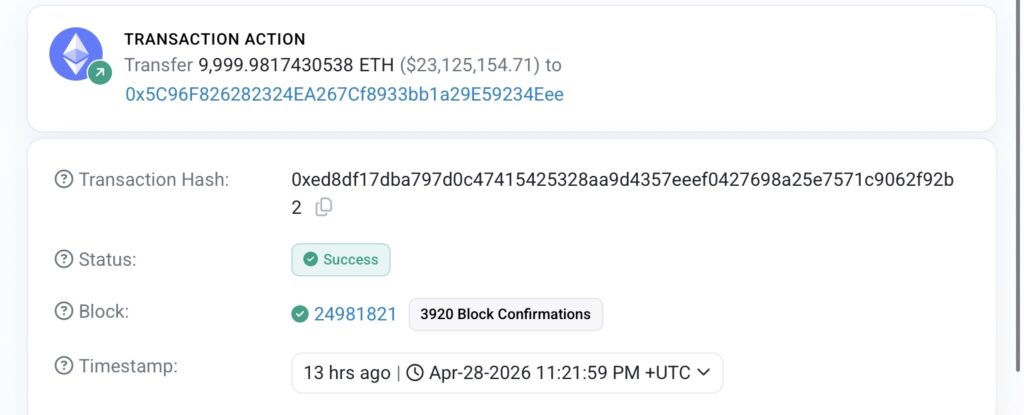
Contrary to fears of a massive dump, analysts are leaning towards a custodian restructuring or a recovery of private keys. In September 2025, another whale had already moved $645 million to a staking service, without impacting the crypto market. Here, the same scenario plays out: no sale, but active asset management. With a daily ETH trading volume of $15 billion, a $23 million transaction goes unnoticed. Proof that early adopters prioritize security over speculation.
Crypto: What are Ethereum whales planning for 2026?
Ethereum whales (holders of 10,000+ ETH) are no longer idle. After years of inactivity, their recent moves reveal a clear strategy: staking, secure custody, or diversification. In 2026, with the transition to Ethereum 2.0 and the rise of Layer 2 solutions, these established players are optimizing their positions. Some, like the whale from the 2015 ICO, are consolidating their holdings in unknown addresses, likely cold wallets or DeFi protocols.
Others, like the one from September 2025, are focusing on staking to generate passive returns (3-6% APY). This trend avoids exchanges to limit the impact on the price. The result? Less selling pressure, but reduced liquidity in the crypto market. With 60% of circulating ETH held by long-term addresses, their next move could redefine the balance between HODLing and active trading.
Ethereum whales aren’t selling; they’re reorganizing. Between staking and securitization, their resurgence signals an era of maturity for ETH. But what if their next step is… a massive sell-off? What do you think?
