



Bitcoin Miner Reserves Drop 61,000 BTC as Public Firms Accelerate Selling
 AI
AI
 CORE
CORE
 2024
2024
 2024
BTC
2024
BTC
This article was first published on Deythere.
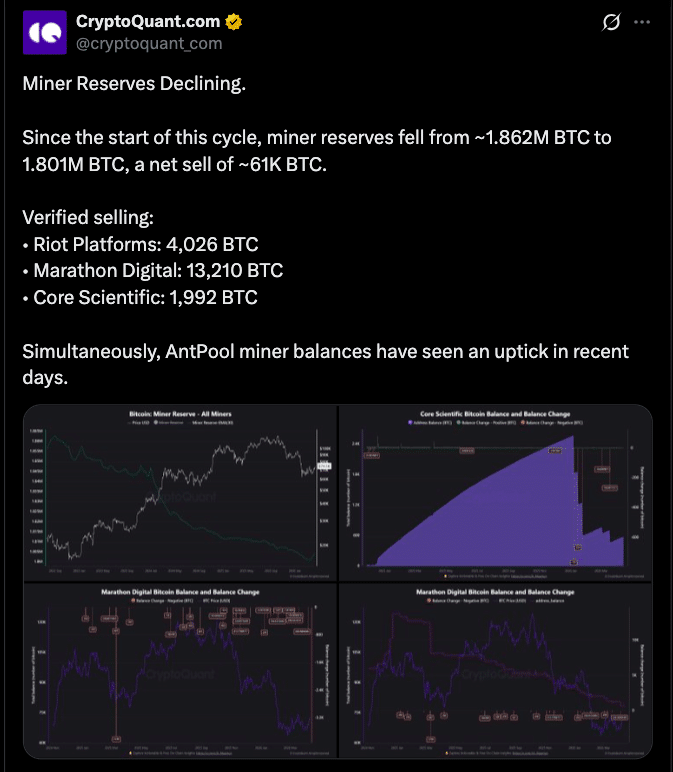
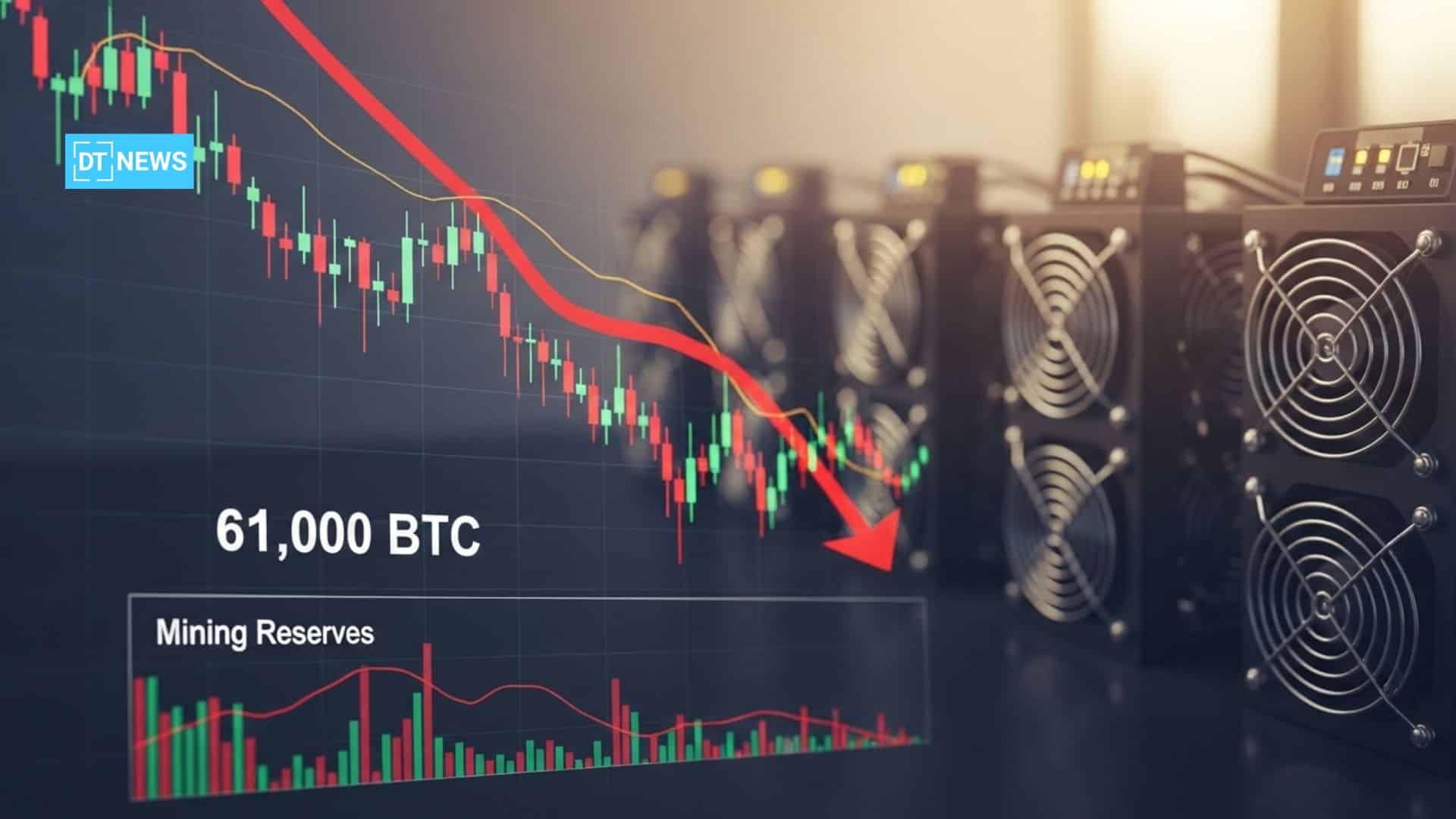
The decline in Bitcoin miner reserves has become one of the most closely watched developments in the market, with fresh on-chain data confirming that miners have sold around 61,000 BTC since the start of the current cycle.
According to data from CryptoQuant, Total miner holdings in BTC price fell from approximately 1.862 million BTC to 1.801 million BTC, indicating that miners were clearly not accumulating anymore. This reveals an even spread of distribution over the cycle, led by publicly listed mining firms.
Riot Platforms, Marathon Digital and Core Scientific have been the most aggressive sellers as they all significantly reduced their holdings. The size of the drawdown is a really different from past cycles, when miners were more likely to hold Bitcoin in anticipation of higher prices.
Public Miners Lead Selling as Treasury Strategies Evolve
This recent drop in Bitcoin miners reserves is being mainly led by public firms who now face much harsher financial expectations compared to previous mining participants.
Verified selling data shows Riot Platforms have sold more than 4,000 BTC. Over 13,000 BTC were offloaded by Marathon Digital. Core Scientific sold a record close to 2,000 BTC
This is particularly evident in Riot’s case. In the first quarter 2026, the company sold 3,778 BTC generating approximately $289.5 million in revenue, with sales exceeding its production during that quarter.
That detail matters. The fact that they are selling more than they produce suggests miners are not only liquidating freshly minted coins, but rather are drawing down reserves.
Instead of acting as long-term holders, many firms simply treat Bitcoin as a balance-sheet asset, selling parts of their holdings to cover operations costs or debt repayment, and/or finance expansion.
 Liquidations Triggered by Rising Costs, Halving Pressure, and AI Pivot
There are a number of reasons for Bitcoin miner reserves to be falling this cycle.
The most immediate is cost pressure. Higher energy prices and operating costs have squeezed margins, leading miners to convert their Bitcoin in order to cover liabilities.
Simultaneously, the 2024 Bitcoin halving slashed block rewards, squeezing miner revenue even as mining difficulty climbed higher. All of these have altered how mining firms operate.
Instead of just depending on Bitcoin price increase, the majority of firms nowadays are selling BTC to meet operational expenses, restructuring balance sheets, and shifting capital to new sources of revenue.
The transformation that is probably most notable is the move toward AI and high-performance computing infrastructure. Reports have shown that firms as Riot and Marathon are selling Bitcoin to pay for expansion into data centers and-ai related services.
Mining firms are not just purely Bitcoin-focused anymore, they are starting to be infrastructure companies and BTC sales is a piece of that transition.
Market Impact: Selling Pressure is Increasing, But Price Holds.
The decline of Bitcoin miner reserves provides a constant supply into the market which can influence price, particularly during periods of low demand.
Miner reserves are often taken to mean sell-side pressure. Falling balances often mean Bitcoin is being sent to exchanges or counterparties for sale.
In this case, it is a large-scale selling. Still, market data indicates that the effect may not be completely bearish. While the distribution has continued, Bitcoin has held important levels, and many trading indicators are suggesting sufficiently strong probabilities that price will stay above $62,000 long enough to bounce in the short term.
This suggests that mining supply is being soaked up by the market, demand remains relatively stable and instead of triggering panic, selling is being priced in
Although the U.S.-listed miners are selling, some mining pools like AntPool have seen a rise in their balances, possibly indicating further accumulation or consolidation by other participants.
This split behavior complicates the narrative. The market is not seeing uniform selling, it is seeing redistribution.
Cycle Shift: Miners Become Persistent Liquidity Providers
The recent trend in Bitcoin miner reserves suggests a deeper change in the way the mining sector engages with the market.
This is unlike previous cycles, where miners were seen as “strong hands,” continually accumulating Bitcoin and thus lowering circulating supply.
Now, that role is changing. Public miners are increasingly acting as stable liquidity providers, consistently liquidating $BTC to fund operations, meet shareholder expectations and support expansion strategies.
This is in tune with the increasing institutionalization of the mining sector. As companies become publicly listed and capital-intensive, holding large BTC reserves without monetization becomes less practical.
This leads to a more predictable supply flow into the market rather than sporadic selling based on extreme cycles.
Conclusion
The drop in Bitcoin miner reserves by 61,000 BTC signifies an ongoing change in how the industry operates.
Miners are no longer simply long-term holders. They are financially active stakeholders who manage capital, balance costs, and diversify sources of revenue.
While this adds some additional selling pressure, it also indicates a more maturing market structure whereby supply is better distributed and less reliant on speculative holding behavior.
Therefore, the question now becomes less focused on whether miners are making sales or not but rather to what extent the market is able to keep absorbing that supply without disrupting price momentum.
Glossary
Bitcoin Halving: Process to cut down mining rewards into half
Miner Reserves: Bitcoin holdings under the control of mining entities.
Selling Pressure: More supply that is entering the market.
TVL : Total Value Locked across Blockchain Ecosystem.
Hashrate: The overall computing power securing the Bitcoin network.
Frequently Asked Questions About Bitcoin Miner Reserves
What are Bitcoin miner reserves?
They are the volume of Bitcoin owned by mining entities, often monitored as a sign of future selling pressure.
What caused the 61,000 BTC drop of Bitcoin miner reserves?
Because major mining companies are selling their coins to cover costs, manage balance sheets and fund expansion.
Who’s selling the most Bitcoin?
Amongst the top sellers are Riot Platforms, Marathon Digital and Core Scientific.
Is miner selling bearish for Bitcoin?
It can exert short term pressure, but could also signal a normal cycle of profits taking and redistribution.
References
