



Bitcoin Whales Dive In as FTX Recovery Fractal Points to $80K — Is BTC’s Rebound Ready?
BTC
Key Highlights
- wo whale wallets have withdrawn a combined $140.78 million in BTC from major exchanges in the past week — including 1,635 BTC ($110.7M) from Bybit, Binance, Bullish.com, and OKX — signaling aggressive accumulation and long-term conviction at current price levels.
- A post-FTX crash recovery fractal — identified via a nearly identical 51-bar structure — shows BTC's current 2026 price action mirroring the exact setup that preceded a powerful recovery rally in late 2022.
- Bitcoin is consolidating between $65,000 and $70,000 after briefly touching $76,000 earlier this month — holding resilient despite ongoing geopolitical tensions from the US-Israel-Iran conflict.
- $66,000 is the critical support to defend — while a daily close above $70,000 is the immediate resistance trigger that could confirm the fractal and open the path toward $78,000–$80,000.
Bitcoin is holding steady in a critical consolidation zone in the final days of March 2026 — with two powerful signals converging simultaneously: aggressive whale accumulation totaling over $140 million in exchange withdrawals in a single week, and a striking technical fractal that mirrors the post-FTX crash recovery structure that preceded one of Bitcoin’s most powerful rallies in recent history.
As of March 31, 2026, BTC is trading at $67,597.40, up a modest +0.28% in the past 24 hours and +0.28% over the past 30 days, with a market capitalization of approximately $1.35 trillion.
 Bitcoin (BTC) Price/Source: Coinmarketcap
Price Overview
Bitcoin reached its all-time high of $126,198 in October 2025 — and has since corrected approximately 46% to the current $67,000–$67,600 consolidation range amid broader market weakness and challenging macroeconomic conditions driven primarily by the ongoing US-Israel-Iran geopolitical conflict.
Despite the correction magnitude, BTC has demonstrated notable resilience in recent weeks — holding the $65,000–$70,000 range consistently and briefly reclaiming $76,000 earlier in March 2026 before pulling back into the current consolidation zone. This range-bound behavior — occurring against a backdrop of persistent geopolitical uncertainty — is consistent with the accumulation phase that typically precedes major directional moves in Bitcoin’s historical price structure.
As we covered in our Bitcoin six consecutive red months and BARR pattern analysis, March 2026 is closing as a historically significant month — with the potential to complete the longest losing streak in Bitcoin’s recorded history before a significant reversal. Today’s whale accumulation data and FTX fractal add further weight to that thesis as the month closes.
Whales Withdraw $140M From Exchanges — Aggressive Accumulation Signal
While retail activity remains measured and broadly cautious, large Bitcoin holders are sending an unmistakable signal — moving significant quantities of BTC off exchanges and into self-custody at the current price level.
According to Lookonchain’s report on March 31, 2026:
“Whales are accumulating $BTC.”
Two specific on-chain movements stand out:
Wallet 15oD9P — 1,635 BTC ($110.7 million) This wallet has withdrawn 1,635 BTC worth $110.7 million from four major exchanges — Bybit, Binance, Bullish.com, and OKX — over the past week. The multi-exchange withdrawal pattern suggests a deliberate, systematic accumulation strategy rather than a single opportunistic purchase — the behavior of an institutional-scale participant building a position across multiple venues to minimize market impact.
Wallet bc1q3a — 450 BTC ($30.08 million) A newly created wallet withdrew 450 BTC worth $30.08 million from FalconX just 6 hours before the Lookonchain report — a fresh wallet specifically created for this withdrawal suggesting a new institutional participant entering at current price levels.
 BTC Whales Buying/Source: Lookonchain
Combined: $140.78 million in BTC moved off exchanges in under one week.
These large off-exchange withdrawals suggest that sophisticated investors are moving BTC into cold storage or self-custody, reducing immediate selling pressure and signaling long-term conviction at current price levels.
This fits into a broader pattern: whale addresses (typically 10–10,000 BTC holders) have resumed net buying, and on-chain data shows continued accumulation as price stabilizes near $67k–$71k.
FTX Crash Recovery Fractal — 51-Bar Structure Points to $78K
Beyond the on-chain accumulation signal, the technical chart is presenting one of the more compelling fractal comparisons Bitcoin has produced in the current cycle.
A side-by-side analysis reveals a striking structural similarity between Bitcoin’s current February–March 2026 price action and the post-FTX crash recovery phase in late 2022 — the exact setup that preceded one of BTC’s most powerful recovery rallies in recent history.
The 2022 FTX Recovery Reference:
Following the FTX collapse in November 2022 — one of the most significant negative catalysts in Bitcoin’s history — BTC formed a specific consolidation structure characterized by:
- Sharp wick lows (marked with pink circles) — capitulation candles that tested extreme low prices before recovering
- Choppy, range-bound consolidation — weeks of sideways price action that frustrated both bulls and bears
- Local higher highs (marked with green circles) — building higher lows within the consolidation before the breakout
- Volume profile of approximately 4.61M — consistent, moderate volume throughout the consolidation phase
- 51-bar structure — the entire setup from the FTX low to the recovery breakout spanned approximately 51 bars on the daily chart
Following the completion of this 51-bar structure, Bitcoin broke out decisively to the upside — initiating the recovery rally that eventually carried BTC to new all-time highs in 2024–2025.
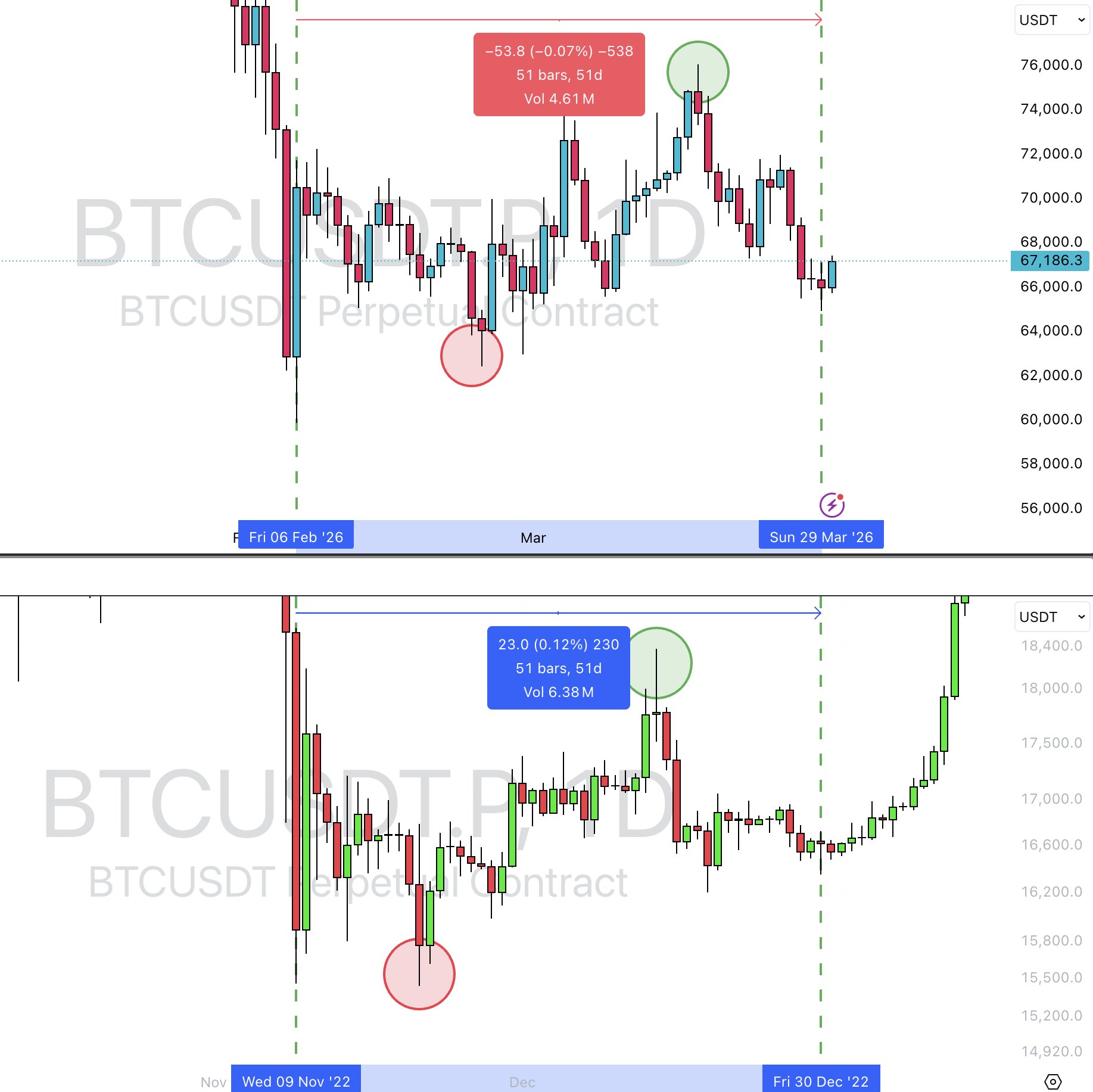 FTX Crash BTC Recovery Fractal/Credits: @Peter_thoc (X)
The Current 2026 Setup:
Bitcoin’s February–March 2026 price action mirrors this structure across every measurable element:
- Nearly identical sharp wick lows — the same pink circle capitulation behavior visible at the cycle lows
- Same choppy consolidation pattern — range-bound price action between $65,000 and $70,000 mirroring the 2022 structure in both duration and character
- Matching green circle local highs — higher lows building within the consolidation zone
- Volume profile of approximately 6.38M — slightly higher than 2022 but consistent with the same consolidation behavior
- 51-bar / 51-day structure — the current consolidation is spanning the same approximate duration as the 2022 FTX recovery setup
The near-perfect alignment of these five structural elements across two completely different market cycles — separated by four years and entirely different macro conditions — is what makes this fractal genuinely noteworthy rather than superficial pattern-matching.
This fractal adds a third independent technical layer to the 2022 reversal structure we previously documented in our 2022 reversal fractal analysis — where BTC’s current price action was already showing striking structural similarities to the 2022 recovery setup
If the 2026 fractal continues to play out as the 2022 reference did, Bitcoin could be preparing for a similar impulsive upside move once the current consolidation resolves — potentially targeting the $78,000–$80,000 range as the immediate recovery objective.
What’s Next for Bitcoin?
The convergence of $140M+ in institutional whale withdrawals, a 51-bar FTX recovery fractal, and the historical context of a potential six-month red streak completion — as documented in our Bitcoin red streak and BARR analysis — creates one of the most multi-layered bullish confluence setups Bitcoin has presented in the current cycle.
Bullish Scenario
- $62,510 holds as strong support on a daily closing basis — the fractal structure remains intact
- Daily close above $76,000 — the immediate resistance trigger that confirms the consolidation is resolving to the upside
- $78,000–$80,000 target activates — the measured move equivalent to the 2022 post-FTX recovery
- Whale accumulation continues building — reducing exchange supply and creating structural upside pressure
- Geopolitical de-escalation in the US-Israel-Iran conflict removes the primary macro headwind
Bearish Scenario
- Daily close below $62,510 — primary support breaks and the fractal structure weakens significantly
- Whale accumulation reverses — exchange inflows increase as large holders begin distributing
- FTX fractal diverges — 2026 consolidation extends beyond the 51-bar structure without resolving to the upside
- Geopolitical escalation maintains persistent risk-off pressure — delaying the recovery regardless of on-chain and technical signals
- Next meaningful support below $62,510 sits near the $60,000 cycle low identified in our BTC bottom signal analysis
Frequently Asked Questions
What do large Bitcoin exchange withdrawals signal about price direction?
Large BTC withdrawals from exchanges to self-custody or cold storage reduce the liquid sell-side supply available on exchanges — creating upward price pressure as demand competes for less available BTC. When institutional-scale wallets withdraw $140M+ in a single week, it signals long-term conviction at current price levels and deliberate accumulation rather than near-term selling intent.
What is the FTX recovery fractal and why does it apply to Bitcoin’s current setup?
The FTX recovery fractal refers to the specific consolidation structure Bitcoin formed after the FTX collapse in November 2022 — a 51-bar pattern of sharp wick lows, choppy consolidation, and building higher lows that preceded a powerful recovery rally. Bitcoin’s current February–March 2026 price action mirrors this structure across five independent measurable elements — making it one of the more compelling technical fractals of the current cycle.
What is Bitcoin’s price target if the FTX fractal plays out?
If the 2026 fractal continues to mirror the 2022 FTX recovery structure, Bitcoin could target the $78,000–$80,000 range as the immediate recovery objective. A daily close above $76,000 is the first confirmation trigger — while $62,510 must hold as support for the fractal to remain valid.
What is the most important support level for Bitcoin right now?
$62,510 is the critical support level to defend in the current setup. A sustained daily close below this level would weaken the fractal structure and signal that the consolidation is extending rather than resolving to the upside. The next meaningful support below $62,510 is near the $60,000 cycle low.
How does today’s whale accumulation connect to the broader Bitcoin bottom thesis?
Today’s Lookonchain data showing $140M+ in BTC exchange withdrawals adds a third independent signal to the current Bitcoin bottom thesis — alongside the STH inflow multi-year low and 2022 reversal fractal identified in our previous analysis and the 61,568 BTC accumulated by whale wallets over the past month. Three independent on-chain signals pointing in the same direction simultaneously represents one of the stronger confluence setups in the current cycle.
What is the significance of Bitcoin potentially completing six consecutive red monthly closes?
As documented in our Bitcoin red streak and BARR analysis, six consecutive red monthly closes would tie the longest losing streak in Bitcoin’s entire recorded history — previously seen only once between August 2018 and January 2019. The last time this occurred, Bitcoin delivered a 300% rally in the following five months — making the March 2026 monthly close one of the most historically significant data points in the current cycle.
Disclaimer: The views and analysis presented in this article are for informational purposes only and reflect the author’s perspective, not financial advice. Technical patterns and indicators discussed are subject to market volatility and may or may not yield anticipated results. Investors are advised to exercise caution, conduct independent research, and make decisions aligned with their individual risk tolerance.
Also Read: Chiliz (CHZ) Builds Strong Setup Ahead of 2026 FIFA World Cup — Will It Rally Like 2022?
