



Building a revenue engine that gets stalled deals moving by Oluwatunmise ‘Mise’ Ishola
 AI
AI
 RND
RND
 TIMELESS
 WHEN
WHEN
 OS
OS
When deals slow down, most teams panic and default to more check-ins, endless “just bumping this” emails, and internal pressure. The hard truth? None of that actually works. Deals don’t get stuck because reps aren’t pushing hard enough. They stall because the operating system underneath your pipeline is unclear or missing entirely. Here’s how to unstick stalled sales deals for good by building a simple, predictable revenue engine that turns heavy, drifting opportunities into ones that glide forward on their own.
I’ve learned this both from being inside fast-moving sales teams and from helping operators clean up messy pipelines: deals don’t stall because reps aren’t pushing hard enough. They stall because the operating system underneath the pipeline is unclear or completely missing. And once you fix the system? Deals that felt heavy suddenly start moving again.
So let’s talk about how to build that system in a way that feels simple, human, and predictable.
Phase 1: Diagnose the blockage (The honest part)
Whenever a deal feels stuck, don’t start with tactics. Don’t start with “what do I say next?”
Start with a simple question: “What exactly is slowing this deal down?”

There are only four real reasons. Everything else is just noise layered on top.
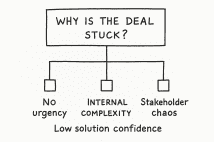
The first reason is that the buyer doesn’t actually feel urgency yet. If the pain isn’t quantified and the cost of waiting isn’t clear, they won’t move. People don’t speed up until they understand what they lose by staying still.
The second reason is that their internal process is confusing. Legal, finance, IT, procurement… you know how it goes. And most buyers genuinely don’t understand their own approval path. If you haven’t mapped this out with them, it’s almost guaranteed the deal will drift.
The third is misalignment on their side. Too many stakeholders and no real owner. It’s like trying to sail a boat with ten people holding the wheel in different directions.
And the fourth is that they’re not fully confident in the solution yet — maybe they love the idea, but something about the final step still feels risky.
Once you know which category your deal falls into, the next steps become almost obvious. It’s like having an x-ray instead of guessing.
Phase 2: Build the pipeline OS (This is where the magic starts)
Here’s the part most teams skip, but it’s honestly the entire difference between deals that glide and deals that drag.
Instead of trying random tactics, build a system that automatically pushes deals forward. Think of it like a calm, predictable rhythm where every part of the process is doing its job.
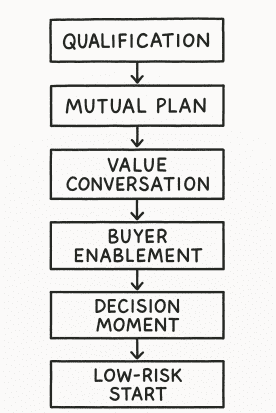
The first part of that rhythm is qualification – and I mean real qualification. Not “the call felt good” or “they liked the demo.” I mean: is there actual pain? Do we know the real decision-maker? Does the timeline matter? Is there a budget owner, or are we hoping one magically appears?
You can save yourself so much frustration just by being brutally honest at this stage. Unqualified deals are exciting at the beginning and disappointing at the end. Qualified deals are quiet at the beginning and beautiful at the end.
Once the deal is real, you move into creating a mutual plan. This is where you and the buyer literally agree on how you’ll get from “this looks interesting” to “we’re signed.” Dates, steps, and people – make sure everything is out in the open. Buyers actually appreciate this more than we think; it makes their lives easier and removes the fear of getting it wrong.
Then comes the value conversation, which is where urgency comes back into play. You’re not selling features. You’re helping them understand the financial outcome. The pain they’re trying to solve. What waiting another three months costs them. When this is clear, the buyer starts pushing the deal forward with you.
After that, you shift into buyer enablement. This is honestly one of the most underrated parts. So many deals slow down because the buyer doesn’t know what to do next. When you give them a simple timeline, a short internal pitch deck, or clarity on who they need to involve, you remove so much friction it’s ridiculous.
Eventually, you get to a point where you need clarity from them. And this doesn’t have to be tense. You can be warm and direct: “Is this still a priority for this quarter?” or “Does this still make sense to keep moving now?” Buyers trust you more when you don’t dance around these things.
And if they want to move forward but feel nervous about committing, that’s when you offer a low-risk way to start. A pilot. A phased rollout. A small test team. It shifts them from “big scary decision” to “small safe experiment,” and that’s usually the momentum they needed.
Everything in this OS works together. It’s not a bunch of random tactics; it’s a flow.
Phase 3: System alignment (The part nobody talks about enough)
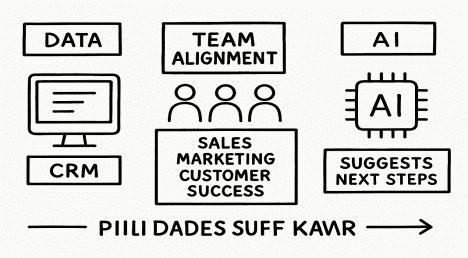
This is where most teams fall apart, but also where the biggest wins come from.
The first thing is data. If your CRM isn’t accurate, everything becomes harder. From forecasting, prioritisation, next steps, and handoffs, everything becomes a blur. A pipeline lives or dies on how much the team respects the system. If information is scattered in Slack, Notion, WhatsApp, and private notes… the deal is already suffering before you even open your mouth.
Then there’s team alignment. Sales, marketing, and customer success need to think about the buyer in the same way: the same ICP, the same definition of a real opportunity, and the same narrative around value. When these teams speak different languages, deals stall in the middle because the handoffs are weak.
And lastly, AI. AI isn’t the hero, but it is the engine that keeps the small things from slipping. It notices when a key stakeholder goes quiet. It flags sentiment changes. It reminds you of timelines. It keeps the CRM clean. It suggests next steps.
You still make the strategic decisions, but AI removes the friction.
Phase 4: The Timeless Rules
I’ve seen this across regions, industries, and company sizes, from early-stage teams to big global operations. The rules don’t change.
Simplicity always beats complexity.
Clarity always beats enthusiasm.
Alignment always beats raw activity.
Momentum always beats “hopeful energy.”
And systems always beat tactics.
When the OS is strong, the pipeline feels lighter. Deals move with less force. Forecasting becomes honest. Team morale goes up. And you start closing business in a way that feels sustainable instead of chaotic.
A stalled deal isn’t a dead deal.
It’s just a signal that the system around it needs tightening.
Once the OS is in place, the whole engine starts breathing again.
And that’s the version of sales I want more teams to experience, the version that feels intentional, strategic, and actually built to win.
