



Ethereum Breaks Below $2,000 as Its Most Ambitious Upgrade Cycle Fails to Move the Price
ETH
 FUSAKA
 BEAM
BEAM
 BEAM
TRX
BEAM
TRX
Key Takeaways
- ETH breaks below $2,000, RSI hits 20.74.
- 50 SMA at $2,097 sits well above current price.
- ETH Binance volume near historical lows.
- ZK-proving times cut from 16 minutes to 10 seconds.
- Beam Chain consensus redesign targeted for 2027.
What the ETH Chart Shows
On the one-hour Binance chart from TradingView, Ethereum opened the March 24 session around $2,160 and pushed to a high near $2,190 on March 25 midday before a sharp selloff began. Price dropped through $2,100, $2,080, and $2,060 across March 26 before a brief consolidation.
March 27 brought the second leg lower, a sharp morning drop broke below $2,000, hitting a low of $1,971 before the latest candle closed at $1,987 at the time of writing – couple of hours after Bitcoin dropped under $68,000.
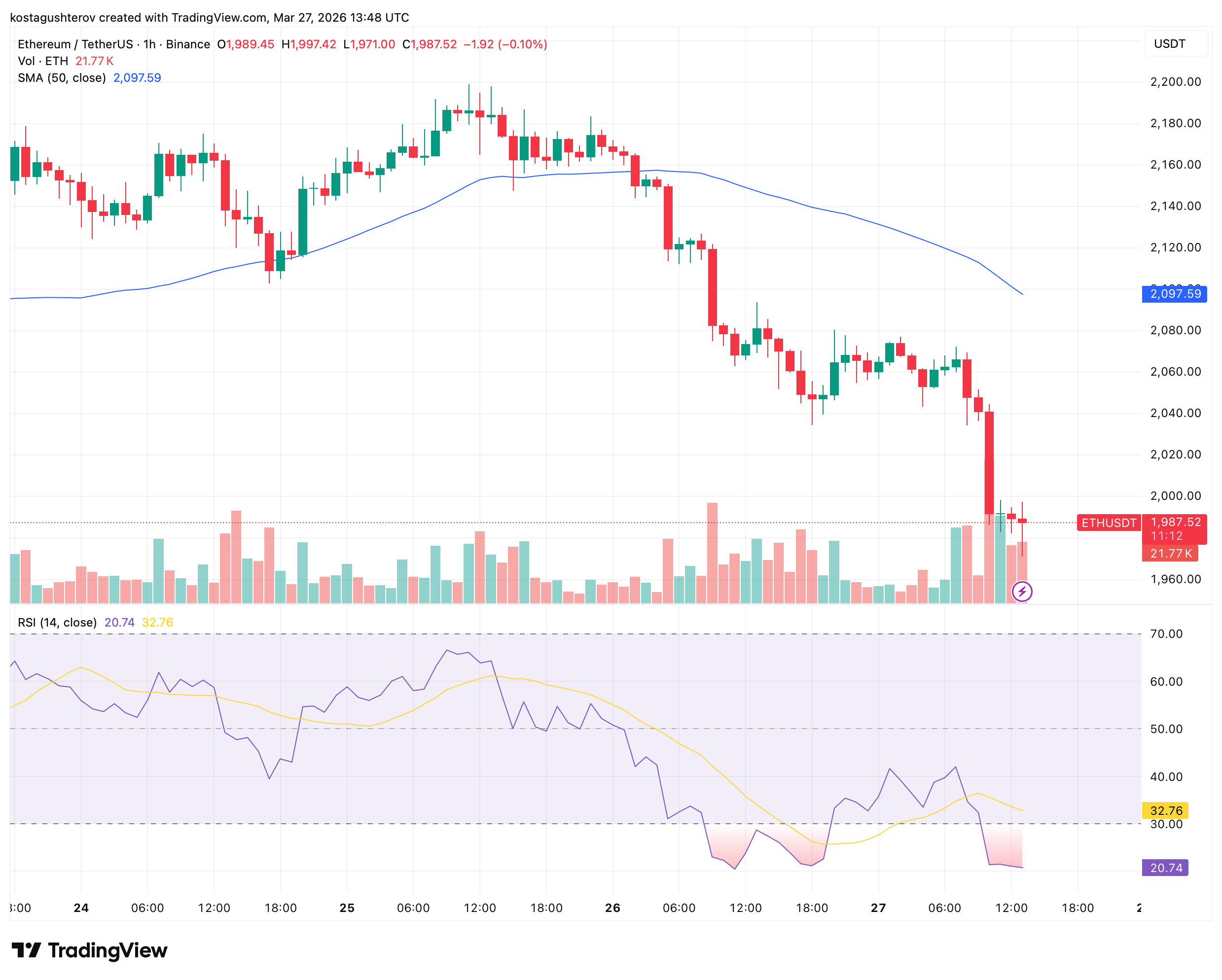
The 50-period simple moving average sits at $2,097.59, more than $110 above current price and sloping downward. Every recovery attempt has to close that gap before the technical picture changes.
The RSI reads 20.74 against a smoothed signal at 32.76. That twelve-point gap between raw momentum and its average is the widest separation visible on the chart. Buying conviction has crossed well below its average and kept falling. The reading sits in the most deeply oversold territory of the session. A condition, not a signal — and the volume data explains why the condition has no floor.
What the Volume Data Says
CryptoQuant’s Major Asset Trade Volume on Binance charttracks ETH monthly trading volume from early 2023. The historical low appeared around September 2023, when ETH volume fell into the $80–90 billion range — a point CryptoQuant describes as where market activity truly dried up.
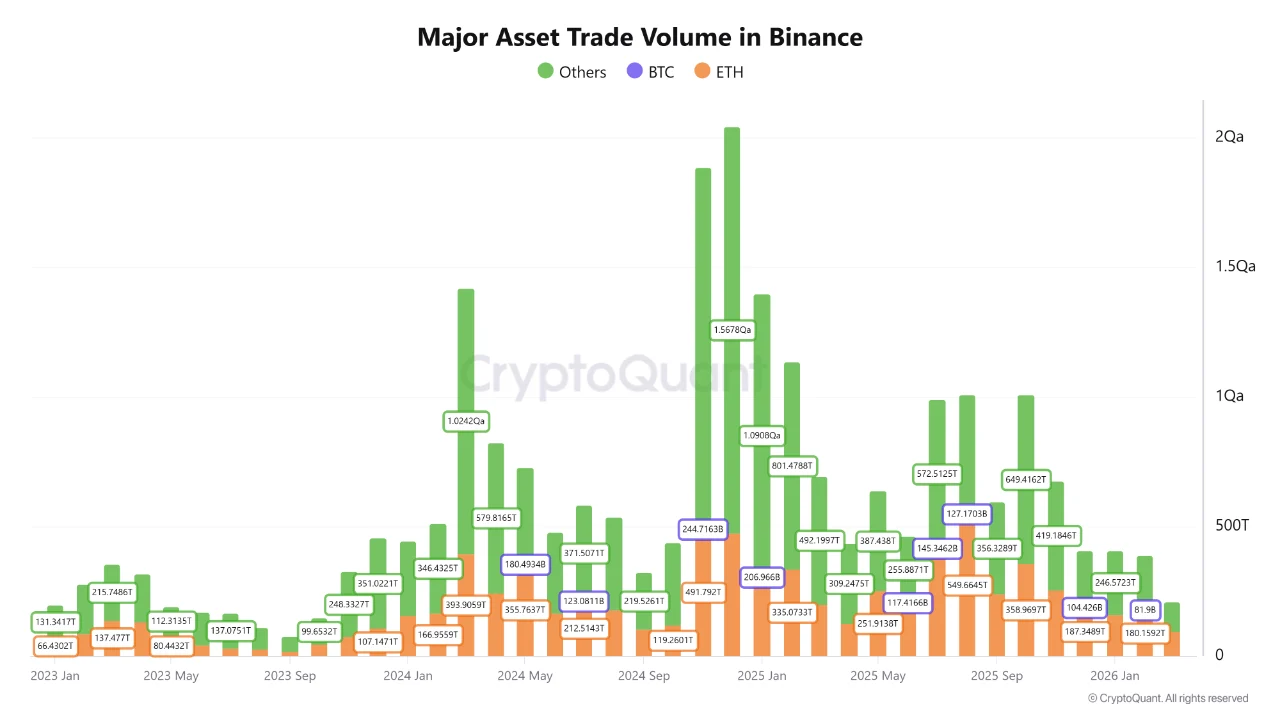
Current ETH volume on Binance sits at approximately $170-180 billion in the broader trend, but the January 2026 data point shows it compressing back toward $81.98 billion – within range of that 2023 floor. The market is not at the bottom. It is operating near a bottom zone, and the distinction matters for what price can and cannot do from here.
In low-volume environments, liquidity thins and price becomes disproportionately easy to move. Small sell orders push price down sharply. Recovery attempts lack the volume to hold, producing what CryptoQuant describes as fake rallies — brief moves higher that reverse without confirmation. The dominant tendency in these conditions is for price to drift lower under its own weight rather than establish a base.
Binance’s role makes this data globally significant. As the largest liquidity hub in the spot crypto market, volume trends on Binance reflect shifts in global risk appetite rather than exchange-specific behaviour. A significant share of institutional and large investor activity routes through Binance. CryptoQuant’s conclusion from the current data is direct: large investors consider the market expensive for buying and cheap for selling. Until whales shift from passive to active buying, the structure supports further downside.
That passivity has persisted through six months of technical development that would, in a different macro environment, be generating institutional demand.
Why Past Upgrades Have Not Moved the Price
The Fusaka upgrade deployed on December 3, 2025, introducing PeerDAS, Peer Data Availability Sampling, which allows validators to verify small samples of block data rather than downloading entire blocks. It also expanded blob capacity for Layer-2 networks through Blob Parameter Only changes, directly reducing L2 transaction costs. Cheaper L2 infrastructure should attract users and capital to the ecosystem. Volume near its 2023 floor says the demand did not follow.
The Pectra upgrade‘s EIP-7702 feature, which solidified through this period after its May 2025 deployment, allowed regular wallets to temporarily act as smart contracts for batched transactions, a friction reduction for everyday Ethereum use that should lower barriers for new participants. Participation metrics moved the other way.
The most technically significant milestone arrived in early 2026. Research teams cut ZK-proving times from 16 minutes to under 10 seconds, making 99% of Ethereum blocks provable in near real-time. This is not an incremental improvement. It is a foundational shift in what ZK-based scaling can deliver at production scale. In February 2026, developers locked the scope for the Glamsterdam upgrade, targeting parallel execution and a gas limit approaching 100 million. The technical foundation for a substantially more capable network was confirmed. ETH broke below $2,000 the same month.
Each of these developments expanded what Ethereum can do. None of them changed what the market is willing to pay for it right now.
READ MORE:
TRX Gains While Crypto Market Bleeds as Anchorage Digital Brings Institutional Custody to TRON
What Is Still Coming
The Glamsterdam upgrade, targeted for the first half of 2026, introduces Enshrined Proposer-Builder Separation, removing reliance on third-party relays and strengthening censorship resistance at the protocol level. The second half of 2026 brings the Hegotá upgrade with FOCIL, Fork-Choice Enforced Inclusion Lists, a mechanism preventing validators from selectively excluding transactions. Both harden Ethereum’s decentralisation guarantees at the base layer. Neither is a user-facing feature.
By end of 2026, the Ethereum Foundation has mandated 128-bit provable security across all zkEVM teams, moving the ZK ecosystem from experimental to production-grade. That deadline is a forcing function for the entire ZK development pipeline.
According to report by The Block, the Beam Chain might in 2027 for testnet trials. It is a proposed complete redesign of Ethereum’s consensus layer using SNARKs and post-quantum cryptography, targeting finality in seconds rather than minutes. Between 2027 and 2030, ZK-EVMs are expected to become the primary block validation method, enabling gas limit increases at a scale not currently possible without security tradeoffs.
Verkle Trees, also a 2027 candidate, would allow stateless clients, nodes that no longer need to store the entire blockchain history to verify blocks, reducing hardware requirements for network participation by orders of magnitude, according to information, shared by Bitget.
The roadmap from here through 2027 is more consequential than anything Ethereum has shipped so far. The price chart does not reflect it yet.
The Gap Between the Roadmap and the Price
Two major upgrades are scheduled before 2026 ends. Beam Chain testing begins in 2027. ZK-proving times are already down from 16 minutes to under 10 seconds. By any technical measure, Ethereum’s development velocity is higher than at any point in the network’s history.
The price broke below $2,000 this morning regardless.
What the chart and the CryptoQuant volume data make clear is that ETH is not currently trading on what the network is building. It is trading on the same forces compressing every risk asset – geopolitical uncertainty, institutional outflows across all three major crypto ETF products, and a macro environment where large investors on Binance are passive sellers rather than active buyers. Volume on Binance is approaching its lowest level since September 2023.
In that environment, protocol quality and development velocity do not provide a floor. The broader market sets the price, and the broader market is pointing lower.
The network is being built faster than at any point in its history. The price is not reflecting it.
The information provided in this article is for educational purposes only and does not constitute financial, investment, or trading advice. Coindoo.com does not endorse or recommend any specific investment strategy or cryptocurrency. Always conduct your own research and consult with a licensed financial advisor before making any investment decisions.
The post Ethereum Breaks Below $2,000 as Its Most Ambitious Upgrade Cycle Fails to Move the Price appeared first on Coindoo.
