



KOSPI Shatters Records with Historic 6,417.93 Close as South Korean Market Momentum Builds
 MASS
MASS
 APRIL
APRIL
 XMM
XMM
 MMT
MMT
 JMS
JMS
BitcoinWorld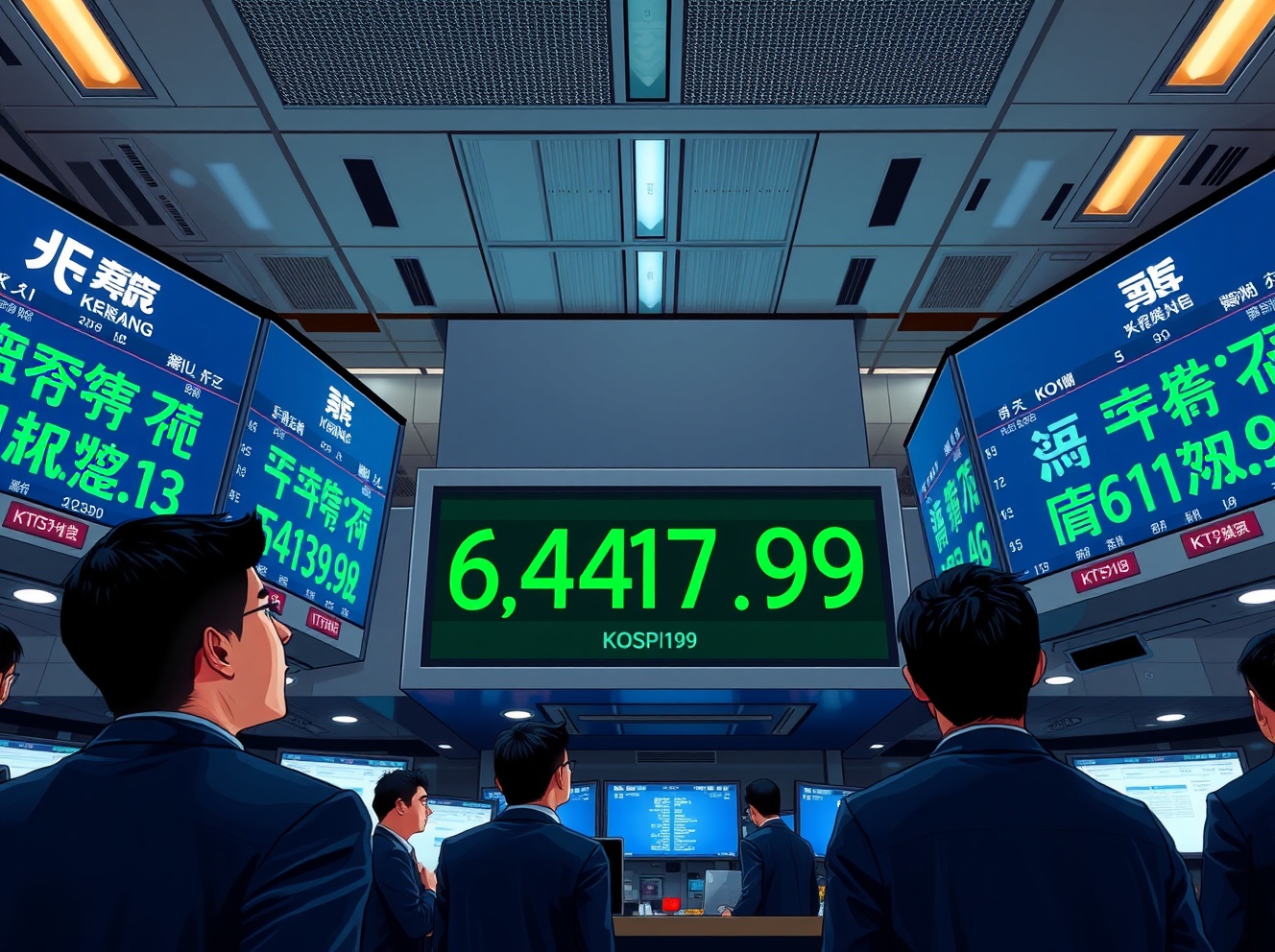
KOSPI Shatters Records with Historic 6,417.93 Close as South Korean Market Momentum Builds
South Korea’s benchmark KOSPI index achieved a historic milestone on April 22, 2025, closing at an unprecedented 6,417.93 points and marking the second consecutive day of record-breaking performance in Seoul’s financial markets.
KOSPI Reaches Unprecedented Heights
The Korea Composite Stock Price Index finished Tuesday’s trading session at 6,417.93, representing a significant gain of 29.46 points or 0.46%. This achievement follows Monday’s previous record close, demonstrating sustained momentum in South Korea’s primary equity market. Market analysts immediately noted the psychological importance of surpassing the 6,400-point threshold for the first time in the index’s history.
Throughout the trading day, the KOSPI displayed remarkable stability. It maintained consistent upward pressure despite global market uncertainties. The index opened strongly and built on early gains throughout the session. Trading volume reached approximately 650 million shares, indicating robust participation from both domestic and international investors. Foreign investors contributed significantly to the positive momentum, recording net purchases of Korean equities for the fifth consecutive session.
Drivers Behind South Korea’s Market Surge
Several fundamental factors supported the KOSPI’s record performance. First, strong corporate earnings from major Korean conglomerates provided substantial foundation. Companies like Samsung Electronics and Hyundai Motor reported better-than-expected first-quarter results. Second, improving economic indicators from China, South Korea’s largest trading partner, boosted export-oriented sectors. Third, the Bank of Korea maintained its current monetary policy stance, providing market stability.
The technology sector led the advance with semiconductor and display manufacturers showing particular strength. Financial stocks also performed well, benefiting from expectations of improved lending margins. Meanwhile, the automotive sector gained momentum following positive electric vehicle sales data from global markets. The following table illustrates sector performance during the record-setting session:
| Sector | Performance | Key Contributors |
|---|---|---|
| Technology | +1.2% | Samsung, SK Hynix |
| Financials | +0.8% | KB Financial, Shinhan |
| Automotive | +0.9% | Hyundai, Kia |
| Chemicals | +0.5% | LG Chem, Lotte Chemical |
Expert Analysis of Market Conditions
Financial experts point to multiple converging factors for the sustained rally. “The KOSPI’s performance reflects improving fundamentals rather than speculative trading,” noted Dr. Min-ji Park, Senior Economist at the Korea Capital Market Institute. “Corporate restructuring efforts and technological innovation are driving genuine value creation.” Park emphasized that foreign investment inflows have been particularly notable, with international funds allocating approximately $2.3 billion to Korean equities during April.
Market strategists highlight several technical indicators supporting continued strength. The KOSPI has maintained position above its 50-day and 200-day moving averages since early March. Additionally, trading breadth remains positive, with advancing issues outnumbering declining stocks by approximately 3:2. The index’s relative strength index (RSI) currently sits at 68, indicating strong momentum without reaching overbought territory.
Historical Context and Market Evolution
The KOSPI’s journey to 6,417.93 represents decades of economic transformation. Established in 1983 with a base value of 100, the index first reached 1,000 points in 1989. It crossed the 2,000-point threshold in 2007 before experiencing significant volatility during the global financial crisis. The index achieved several important milestones:
- 2010: Surpassed 2,000 points recovery
- 2018: First close above 2,500 points
- 2021: Broke through 3,000-point barrier
- 2024: Achieved 6,000-point milestone
South Korea’s market capitalization has grown substantially alongside index performance. Total market capitalization now exceeds $2.1 trillion, representing approximately 110% of the nation’s GDP. This growth reflects both corporate expansion and increasing international recognition of Korean companies. The Korean won has remained relatively stable against major currencies, providing additional confidence for foreign investors.
Global Comparisons and Regional Impact
The KOSPI’s performance stands out in global context. While major indices like the S&P 500 and Nikkei 225 have shown strength, the Korean market’s year-to-date gain of approximately 15% exceeds many developed market averages. Regional Asian markets generally responded positively to the KOSPI’s achievement. Japan’s Nikkei 225 gained 0.3% during the same session, while Hong Kong’s Hang Seng Index advanced 0.4%.
Analysts observe that South Korea’s market performance often serves as a bellwether for regional technology and export sectors. The current rally suggests improving conditions for Asian manufacturing and technology supply chains. Neighboring markets including Taiwan and Singapore typically show correlation with Korean market movements, particularly in semiconductor and electronics sectors.
Institutional Perspective on Sustainability
Major financial institutions maintain cautiously optimistic outlooks. “Current valuations remain reasonable relative to earnings growth projections,” stated James Kim, Head of Research at Mirae Asset Securities. “The KOSPI trades at approximately 12 times forward earnings, which compares favorably to historical averages and regional peers.” Kim emphasized that corporate governance improvements and shareholder return policies have enhanced investment appeal.
Regulatory developments also support market stability. The Financial Services Commission recently implemented enhanced disclosure requirements and market surveillance systems. These measures aim to improve transparency and reduce volatility. Additionally, South Korea’s pension funds continue to increase domestic equity allocations, providing structural support for the market.
Economic Implications and Future Outlook
The record KOSPI performance carries significant economic implications. Higher equity valuations typically support consumer confidence and spending through wealth effects. Corporate fundraising becomes more accessible with stronger share prices, potentially accelerating investment and innovation. The government welcomes strong market performance as validation of economic policies, though officials emphasize the need for balanced growth across all economic sectors.
Market participants will monitor several key factors in coming weeks. Upcoming earnings reports from major corporations will provide crucial fundamental data. Global central bank policies, particularly from the U.S. Federal Reserve, will influence capital flows. Geopolitical developments in the region may affect investor sentiment, though current diplomatic engagements suggest stability.
Conclusion
The KOSPI’s historic close at 6,417.93 represents a significant milestone for South Korea’s financial markets and broader economy. This achievement reflects improving corporate fundamentals, sustained foreign investment, and positive economic momentum. While markets naturally experience fluctuations, current conditions suggest the potential for continued strength. The KOSPI record high demonstrates South Korea’s evolving position in global financial markets and provides optimism for future economic development.
FAQs
Q1: What exactly does the KOSPI index measure?
The KOSPI (Korea Composite Stock Price Index) tracks the performance of all common stocks traded on the Korea Exchange’s main board. It serves as the primary benchmark for South Korea’s stock market, representing approximately 95% of total market capitalization.
Q2: How significant is a 0.46% daily gain for the KOSPI?
While 0.46% represents a moderate single-day movement, achieving this gain to reach a record high carries psychological importance. It demonstrates sustained buying pressure and investor confidence, particularly when occurring for consecutive sessions.
Q3: What sectors contributed most to the KOSPI’s record performance?
Technology companies, particularly semiconductor manufacturers, provided the strongest contributions. Financial and automotive sectors also showed significant strength, benefiting from positive earnings reports and improving economic conditions.
Q4: How does the KOSPI’s current valuation compare historically?
The KOSPI currently trades at approximately 12 times forward earnings estimates. This represents a reasonable valuation relative to historical averages and remains below peak valuation levels seen during previous market cycles.
Q5: What risks could challenge the KOSPI’s continued strength?
Potential challenges include global economic slowdowns affecting exports, currency volatility, geopolitical tensions in the region, and changes in international capital flows. However, current fundamentals suggest resilience against moderate headwinds.
This post KOSPI Shatters Records with Historic 6,417.93 Close as South Korean Market Momentum Builds first appeared on BitcoinWorld.
