






Marsqnet Is Live: Marscoin's Quantum-Ready Testnet Takes Its First Blocks
 MARS
MARS
From Roadmap to Running Code
In April 2026, the Marscoin Foundation published the Quantum Upgrade Proposal — an ambitious plan to make Marscoin among the first Bitcoin-derived cryptocurrencies with native post-quantum cryptography. The proposal outlined three pillars: SPHINCS+ signatures to replace vulnerable ECDSA, RandomX mining to replace Scrypt, and UTXO recycling to fund the transition without inflating the supply.
Today, that proposal has its first tangible proof: marsqnet is live.
Marsqnet is a dedicated development network where Marscoin nodes run a RandomX-enabled proof-of-work path. Multiple nodes have been deployed across real cloud infrastructure, connected to each other, and successfully mined and propagated blocks. This is an actual network producing actual blocks with the mining algorithm that will eventually secure Mars.
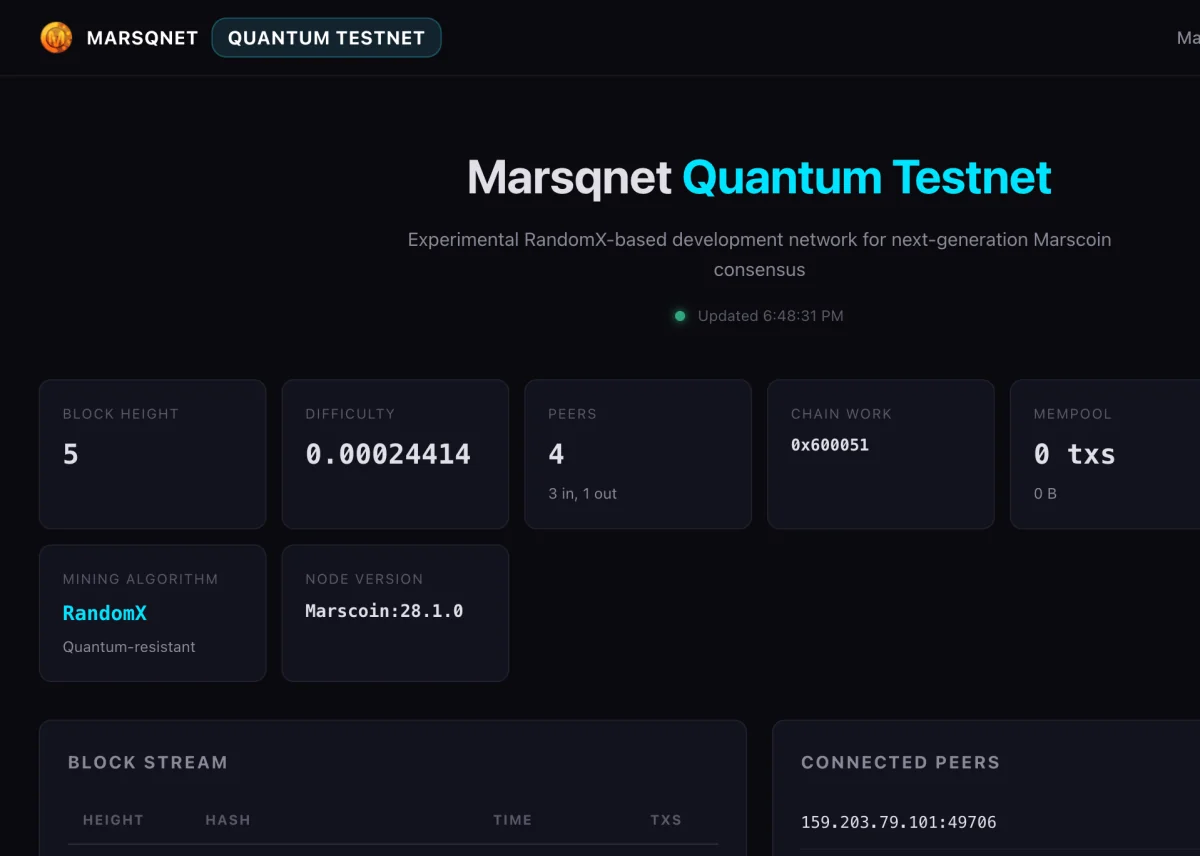
You can see it for yourself: the Marsqnet Quantum Testnet Explorer shows the live network — block height, difficulty, connected peers, and the mining algorithm displayed as RandomX (Quantum-resistant), running on Marscoin Core 28.1.0.
Why This Matters
Marscoin had a strong research direction for the quantum era, but research without running code is just a paper. The gap between roadmap ambition and operational proof needed to be closed.
Marsqnet closes that gap. It proves that:
- RandomX can be integrated into Marscoin’s Bitcoin Core 28 codebase — cleanly, with build-gated isolation so that mainnet consensus is never at risk
- Multiple nodes can sync and mine on the new algorithm — not just locally but across geographically distributed infrastructure
- The development path is reproducible — with pinned dependencies, automated smoke tests, and continuous integration hooks
This is exactly the foundation needed before opening a broader public testnet.
How It Was Built
The engineering team made several deliberate architectural decisions that reflect Marscoin’s philosophy of conservative, auditable protocol development:
Pinned Upstream Sources
RandomX was vendored from tevador’s reference implementation, including the v2 changes merged in February 2026 — the most significant update since the algorithm launched on Monero in 2019. v2 increases total operations per hash by 53%, doubles AES computations, and expands program size from 256 to 384 instructions, all while delivering 5-8% faster hashrates on modern CPUs by utilizing previously idle cycles during memory stalls. Six-plus years without a single ASIC produced. The source is pinned at a known baseline for deterministic provenance, critical for future security audits. For the full technical comparison of Scrypt vs RandomX, see the Academy deep dive.
Build-Gated Integration
All RandomX code paths are isolated behind a compile-time flag. This means the development team can test aggressively in marsqnet environments while the default production build remains completely untouched. Mainnet and testnet are never at risk.
Proof-of-Work Dispatch
A header-aware dispatch layer was introduced so the node can select between Scrypt (current mainnet) and RandomX (marsqnet) based on consensus parameters. This is the same architectural pattern that will eventually enable a clean hard fork activation on mainnet — one block on Scrypt, the next on RandomX, with no ambiguity.
Dedicated Network Identity
Marsqnet has its own network identity — distinct message bytes, ports, and address prefixes — ensuring it can never accidentally interact with mainnet or testnet. It is a clean, isolated sandbox.
What Was Observed
During the initial deployment:
- Multiple nodes came online and connected to each other successfully
- Blocks were mined on the RandomX algorithm and propagated across the network
- All nodes synced to the same chain height
- The two-node smoke test harness passed consistently
- CI automation now runs marsqnet RandomX checks on every code change
This is the first meaningful proof that the RandomX integration works as a real network — not just local test logic. The marsqnet block explorer provides live visibility into network state, block production, and peer connectivity.
The Road Ahead
Marsqnet is the beginning, not the destination. The next milestones:
- Expand the network — from the initial nodes to a geographically diverse fleet, stress-testing latency and propagation
- Cross-platform validation — deterministic RandomX hash vector checks ensuring consistent behavior across Linux, macOS, and ARM architectures
- Operator documentation — bootstrap guides and install scripts so external developers can spin up their own marsqnet nodes
- Semi-public testnet — opening onboarding for external testers and miners who want to participate
- Parallel post-quantum workstreams — address format design, SPHINCS+ signature integration, and wallet migration tooling, all tested against the live marsqnet baseline
Run Your Own Marsqnet Node
Want to try it yourself? The Marsqnet Quickstart Guide on GitHub walks you through building from source, configuring your node, and connecting to the network. The current baseline tag is marsqnet-baseline-2026-04-13.
An Invitation
If you want to work at the edge of cryptocurrency protocol engineering, this is where it’s happening. Marscoin needs contributors in:
- RandomX validation — hardening and hash vector testing
- Mining and pool integration — tooling for the new algorithm
- Post-quantum signatures — the SPHINCS+ pipeline
- Migration safety — wallet UX for the ECDSA-to-PQ transition
- Testnet operations — running nodes, monitoring, observability
The code is open source. The quantum-track PRs are open for review. The marsqnet nodes are running. Join the effort at github.com/marscoin and help shape the protocol that will secure the first financial system on Mars.
