



Trump blockade order sends global oil prices above $100
 JPMORGAN
 BBC
BBC
 POLY
POLY
 HYPE
HYPE
Global energy markets experienced a sharp reversal on Monday, Apr. 13, as oil prices surged more than 7%, climbing back above the $100-per-barrel mark.
The spike followed U.S. President Donald Trump’s order to blockade Iranian ports, a move triggered by the collapse of peace negotiations between Washington and Tehran in Islamabad.
The global benchmark, Brent crude, jumped to $102.02 per barrel, while West Texas Intermediate (WTI) climbed 7.5% to reach $103.78 a barrel.
This volatility comes just days after prices had dipped below $100 during a brief, conditional two-week ceasefire.
With negotiations now failed, investors are increasingly concerned that the international energy crisis is set to worsen.
Related: Trump threatens attacks as U.S. blockade of Hormuz begins
Traders signal conviction on digital platforms
Activity on decentralized trading platforms reflects the high level of market anxiety.
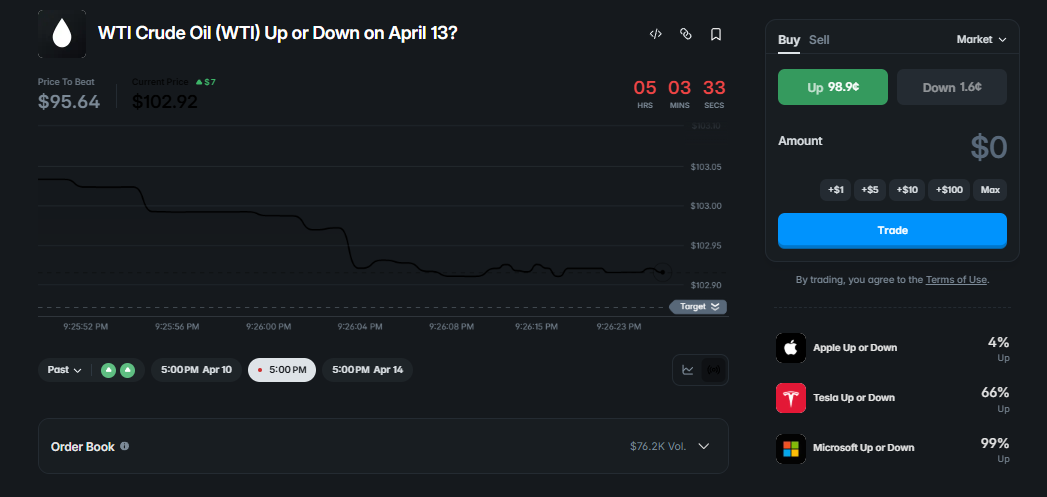
On Polymarket, a crypto-based prediction market site, traders are showing extreme conviction that oil will end the day higher.
As of Apr. 13, the platform shows a 98.9% probability that WTI will finish above the $95.64 "price to beat," leaving only a 1.6% chance for a price drop.
Meanwhile, on the crypto-based platform Hyperliquid, oil futures (OIL-USDH) remained relatively steady near $94.53, down nearly 2% over 24 hours.
While the physical market is surging, the digital platform showed moderate activity with a trading volume of $6.6 million and open interest near $5.5 million, as prices moved between support levels of $95.20 and resistance at $96.90.
Popular on TheStreet Roundtable:
- Gold, silver, oil fuel 65,000% surge in commodity perpetuals
- JPMorgan identifies the lone buyer saving crypto flows
- Analyst slashes Coinbase rating, flags profitability concerns
Critical moment for global supplies
The U.S. naval blockade of the Strait of Hormuz targets a waterway that handles 20% of the world’s seaborne energy shipments.
This escalation occurs at a difficult time for the industry, as the large-scale release of strategic petroleum reserves coordinated by the International Energy Agency (IEA) is nearing its limit.
Despite the ongoing conflict that began on Feb. 28, maritime data from Windward reveals that Iran has managed to export over 58 million barrels of oil from Kharg Island since March 1, BBC reported.
Economic forecasts and rising risks
Financial experts warn that a prolonged blockade could have a devastating impact on global growth.
Morgan Stanley maintained its Brent crude forecast at $110 for the second quarter of 2026, noting that supply chains will take months to normalize even if the waterway eventually reopens.
Bloomberg Economics analysts warned that higher energy costs will likely fuel inflation and damage growth in Asia.
In a "high intensity" scenario where the Strait of Hormuz remains shut for months, analysts Jennifer Welch and Tom Orlik predict oil could skyrocket to $170 per barrel, potentially slowing global economic growth to just 2.2%.
Related: White House advisor to discuss key legislation today
