






U.S. and Iran in Early Ceasefire Talks – What It Means for Crypto Markets
 FRANKLIN
 PRESIDENT TRUMP
 PUMP
PUMP
 PRESIDENT TRUMP
 47
47
- U.S. and Iran are reportedly in early ceasefire negotiations, with the Strait of Hormuz at the center of the deal.
- ETH exchange supply has dropped to an all-time low of 11%, suggesting large-scale accumulation.
- Franklin Templeton has launched a dedicated crypto division with $1.8B already in digital assets.
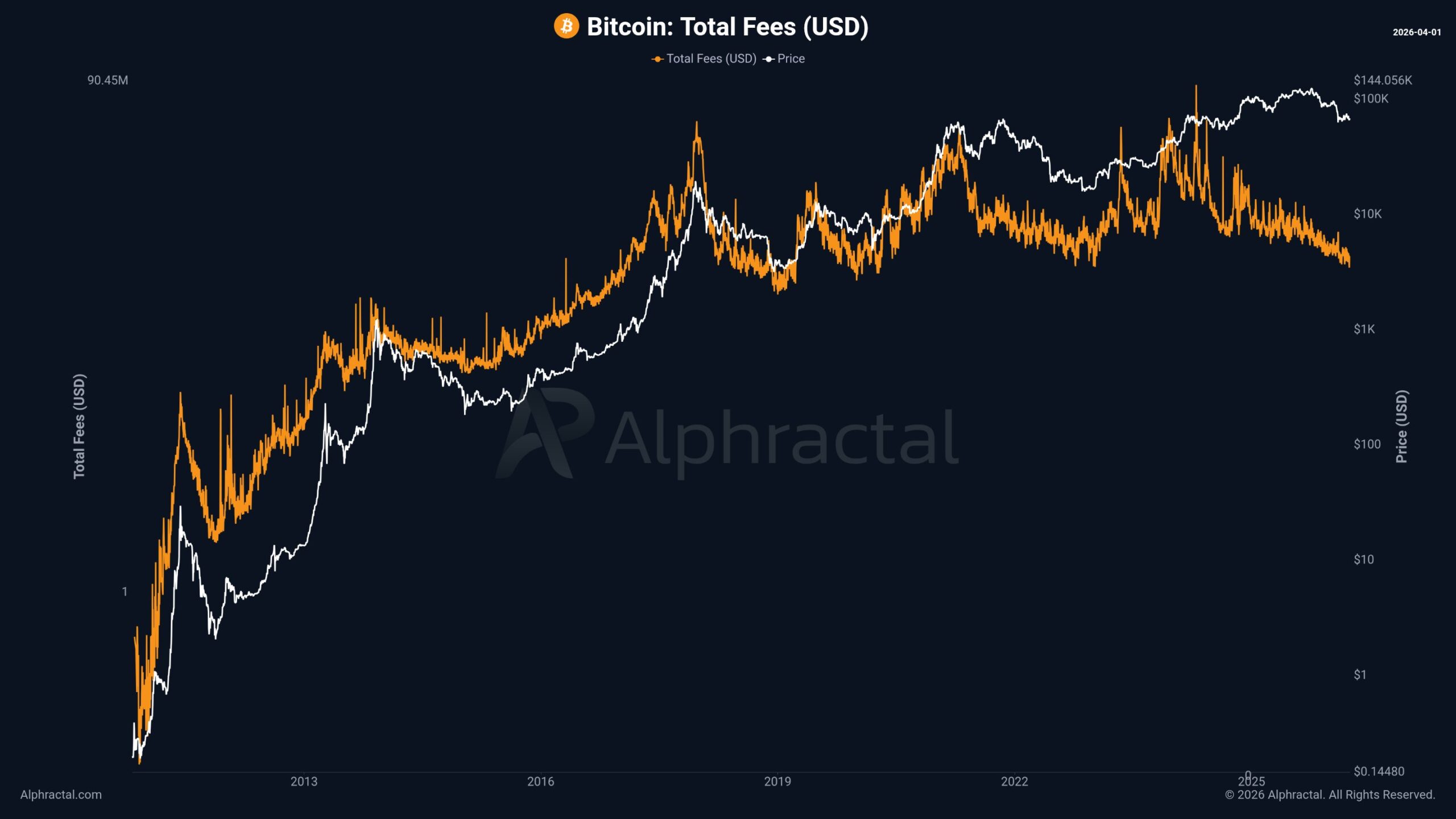
- Bitcoin daily fees have hit six-year lows, a signal that historically precedes sharp volatility.
Three senior U.S. officials have confirmed to Axios that Washington and Tehran are engaged in early-stage negotiations centered on a ceasefire deal that would, in exchange, see Iran reopen the Strait of Hormuz to commercial shipping. The strait is responsible for roughly 20% of global oil transit, and any disruption – or resolution – there carries immediate consequences for risk assets worldwide, crypto included. President Trump has made his position clear: no deal unless the strait is “open, free, and clear.” He also claimed this week that Iran had requested the ceasefire, a claim Tehran’s Foreign Ministry flatly rejected as “false and baseless.”
Iran’s Foreign Minister Abbas Araghchi gave a blunt assessment of where things stand, telling Al Jazeerathat while messages have been exchanged – including direct communication from U.S. Special Envoy Steve Witkoff – “the trust level is at zero,” and that Tehran has yet to formally respond to U.S. proposals. China and Pakistan have both presented peace frameworks along similar lines, with Iran reportedly routing its responses through Islamabad. Whether any of this produces a final agreement remains genuinely unclear.
Markets Are Rangebound, But Watching
For crypto markets, the significance of a ceasefire scenario is straightforward. A resolution in the Gulf would ease oil price pressures, reduce broader macro uncertainty, and historically, that kind of environment has been favorable for risk-on positioning. Bitcoin and Ethereum tend to move with sentiment when large geopolitical unknowns get resolved, and traders are watching closely.
As of today, Bitcoin is trading at $68,413, up 1.01% in the past 24 hours but still down 3.45% on the week, reflecting the broader indecision that has defined the market for weeks. Ethereum sits at $2,140, posting a more encouraging 1.91% gain over 24 hours, though it too remains down 1% on the seven-day chart. XRP is at $1.35, up 1.27% on the day but carrying a 4.25% weekly loss, while Solana has gained 2.16% in the past 24 hours to trade at $84.60 – though its weekly drawdown of 8% stands out as the sharpest among the majors. The short-term gains across the board suggest some tentative optimism, but none of these moves are large enough to signal conviction.
Glassnode’s most recent on-chain report frames the Bitcoin picture in appropriately cautious terms: BTC has been rangebound between $60,000 and $70,000, with spot demand beginning to absorb available supply and derivatives markets resetting to more neutral positioning. Volatility has cooled, but without a clear external catalyst, analysts are skeptical that a sustained breakout materializes on its own.
Ethereum Supply on Exchanges Hits Record Low
What makes the current moment particularly interesting is that several on-chain indicators have converged ahead of this geopolitical development. ETH’s balance on centralized exchanges just hit an all-time low – only 11% of total supply remains available for immediate sale.
That compares to 32% sitting on exchanges back in June 2020. The move lower has not been gradual; between early 2022 and late 2024, the decline was slow and steady, but between then and March 2026 it turned nearly vertical. Whatever is driving the withdrawal of ETH from exchanges, it is happening at a pace that has no historical precedent. Less supply available for immediate sale structurally reduces selling pressure, and at a price of around $2,140, the behavior suggests accumulation rather than distribution.
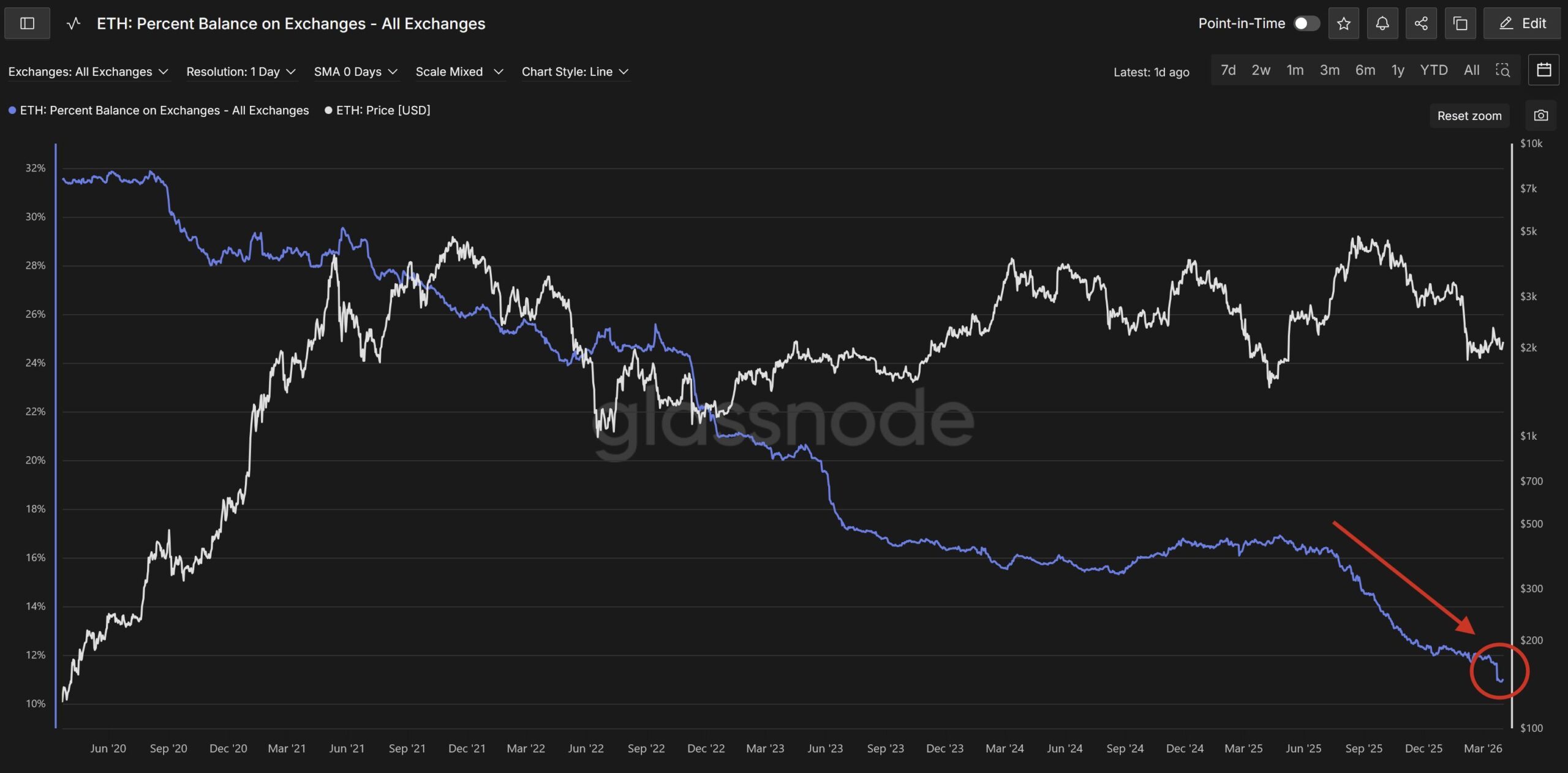
Additionally, Bitcoin reserves on exchanges also declined to 2.7M BTC – again a positive signal for investor sentiment.
Franklin Templeton Goes All-In on Crypto Infrastructure
On the institutional side, Franklin Templeton – one of the largest asset managers in the world – has formally launched a dedicated cryptocurrency division. This is not a passive ETF product.
The firm already has $1.8 billion in digital assets under management and is now building out active crypto strategies for institutional clients. Notably, part of the acquisition that facilitated the division’s launch is being settled in tokenized assets, making it one of the first major on-chain M&A transactions in traditional finance. When a firm managing over $1.5 trillion in total assets decides crypto deserves its own division rather than a line item, that carries a different weight than another hedge fund adding Bitcoin to its balance sheet.
Bitcoin Fee Revenue Flags Weak Network Demand
The one metric that complicates the bullish case is Bitcoin’s transaction fee revenue, which has fallen to levels last seen at the 2022 price bottom – among the lowest in six years when measured in USD.
On a logarithmic scale, the signal is stark. Low fee revenue points to weak network demand, meaning fewer people are actively transacting on-chain. Historically, periods of compressed fee activity have preceded significant moves in either direction. Whether this resolves upward or downward depends largely on what catalyst arrives first.
The Catalyst Question
That catalyst may or may not come from the Gulf. If a ceasefire deal is reached and the Strait of Hormuz reopens, the macro relief alone could be enough to shift market sentiment meaningfully. If the talks collapse – or remain frozen in the current state of mutual distrust – the uncertainty persists and markets continue treading water. Iran’s foreign minister has made clear that no formal negotiations are underway from Tehran’s perspective, and that the conditions for ending hostilities remain far from agreed upon.
The signals are accumulating. Whether they converge into something definitive depends on decisions being made in diplomatic back-channels that, by their nature, remain opaque.
The post U.S. and Iran in Early Ceasefire Talks – What It Means for Crypto Markets appeared first on Coindoo.
