



Why Bitcoin Is Lagging Behind the S&P 500’s $6 Trillion Rally
 RLY
RLY
 ETF
BTC
ETF
BTC
 RALLY
RALLY
 ETF
ETF
This article was first published on TurkishNY Radio.
The S&P 500 melt-up rally is clearly showing that confidence has returned to global markets, but Bitcoin is not reacting in the same way. U.S. stocks have climbed back to record levels, backed by stronger sentiment and steady institutional interest.
Meanwhile, Bitcoin is still trading within a narrow range, struggling to reflect the broader risk-on mood. This gap suggests that, even with supportive conditions, crypto demand is not fully back yet, leaving Bitcoin temporarily out of sync with the momentum seen in equities.
S&P 500 Melt Up Rally Signals Rising Confidence
The recent S&P 500 melt up rally reflects a sharp turnaround from earlier uncertainty. After dropping nearly 10% in the first quarter, the index has recovered strongly, closing at 7,022.95 on April 15, based on official data from S&P Dow Jones Indices.
This recovery has been driven by renewed confidence in large-cap technology firms and easing concerns around global tensions. Economic data has also played a role.
The U.S. Producer Price Index showed only modest increases in March, suggesting that inflation pressures remain manageable for now.
Together, these factors have helped restore risk appetite in traditional markets.
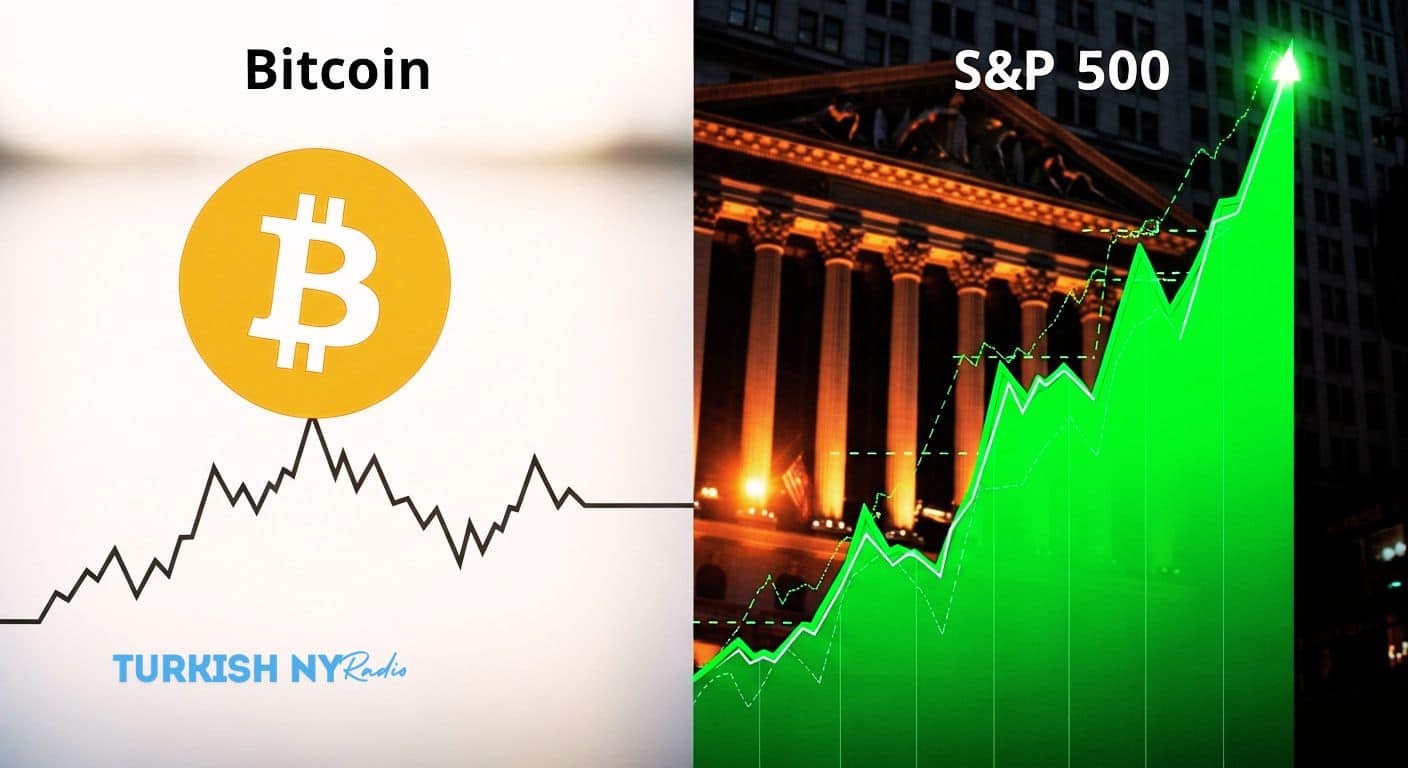
S&P 500 Melt Up Rally Leaves Bitcoin Lagging Behind
In past cycles, a move like the current S&P 500 melt up rally would typically lift Bitcoin alongside equities. This time, the response has been far more muted.
Blockchain.com pricing shows Bitcoin trading near $75,000, still well below its previous high. Rather than breaking out, the asset remains locked in a consolidation phase that has now stretched for several months.
This divergence is unusual. Bitcoin has often acted as a higher-volatility extension of equity trends, amplifying gains during strong market phases. The current behavior suggests that relationship is temporarily weakening.
Capital Flows Tell a Different Story
The gap between stocks and crypto becomes clearer when looking at capital flows. The S&P 500 melt up rally is backed by strong institutional positioning, particularly in large-cap technology stocks tied to artificial intelligence and infrastructure spending.
In contrast, Bitcoin’s inflows remain inconsistent. Spot ETF demand has improved in recent sessions, with daily inflows reaching over $400 million earlier in April. However, these flows have not yet translated into sustained upward momentum.
On-chain indicators also show that capital entering the network is not strong enough to support a decisive breakout. Instead, the market is seeing short-term positioning and quick profit-taking rather than long-term accumulation.
On-Chain Signals Point to a Fragile Recovery
Data from Glassnode highlights that Bitcoin is still hovering near key cost-basis levels for active investors. Holding above these levels is important for maintaining market confidence.
At the same time, realized price metrics suggest that many participants are still cautious. Without consistent inflows, the market lacks the strength needed to push beyond resistance zones.
This explains why the S&P 500 melt up rally has not translated into a similar move in crypto. The equity market is supported by strong narratives and capital rotation, while Bitcoin is still waiting for a more stable demand base.
What Comes Next for Bitcoin
The current situation does not confirm a breakdown in Bitcoin’s long-term outlook. Instead, it points to a delay in participation during a broader risk rally.
For Bitcoin to realign with the S&P 500 melt up rally, several conditions need to be met. Sustained ETF inflows, stronger spot demand, and improved on-chain activity will all play a role.
A move above the $76,000 level could shift market structure and trigger renewed momentum. Until then, the market remains in a holding phase, with traders watching closely for signs of stronger capital commitment.

A Market Waiting for Confirmation
The S&P 500 melt up rally shows that confidence has returned to traditional markets. Bitcoin, however, is still searching for the same level of conviction.
This divergence highlights an important shift. While equities are benefiting from clear growth narratives and institutional demand, crypto markets require stronger internal support to move higher.
Until that support appears, Bitcoin may continue to lag behind, even as global markets push forward.
Summary
- The S&P 500 has surged to new highs, showing that confidence is returning to traditional markets.
- Bitcoin, however, is still hovering around $75,000 and hasn’t followed the same upward move.
- Stocks are benefiting from strong institutional interest, while crypto demand remains uneven.
- On-chain signals suggest traders are still cautious rather than fully committed.
- For Bitcoin to move higher, it likely needs steady inflows and stronger buying support.
Glossary of Key Terms
1. S&P 500 Melt Up Rally
A rapid and sustained rise in the S&P 500 index to record highs, driven by strong investor confidence, liquidity, and institutional buying, often occurring despite prior market uncertainty.
2. Bitcoin Consolidation
A phase where Bitcoin trades within a narrow price range without a clear upward or downward trend, typically reflecting market indecision or a pause before the next major move.
3. Risk-On Sentiment
A market environment where investors are more willing to take risks, allocating capital into equities, cryptocurrencies, and other growth assets instead of safer investments like bonds or cash.
4. Spot Bitcoin ETF
An exchange-traded fund that directly holds Bitcoin, allowing investors to gain exposure to BTC price movements without owning the asset, often attracting institutional capital.
5. Institutional Capital Flows
Large-scale investments from entities such as hedge funds, asset managers, and corporations, which can significantly influence market trends, liquidity, and price direction.
6. On-Chain Data
Blockchain-based metrics that track activity such as transactions, wallet balances, and capital flows, providing real-time insights into market behavior and investor sentiment.
7. Realized Price
An on-chain metric representing the average price at which all Bitcoin in circulation was last moved, often used to assess investor cost basis and key support levels.
8. Resistance Level
A price point where selling pressure tends to increase, making it difficult for an asset like Bitcoin to move higher unless strong buying demand breaks through that level.
FAQs About S&P 500 melt up rally
1. What is the S&P 500 melt up rally and why does it matter?
The S&P 500 melt up rally simply means stocks are rising quickly to new highs, showing strong confidence from investors and steady money flowing into markets.
2. Why isn’t Bitcoin rising along with the stock market?
Bitcoin isn’t moving up as expected because buying interest is still uneven, and many traders remain cautious, even though overall market conditions have improved.
3. How do ETF inflows impact Bitcoin’s price?
ETF inflows bring in large investors, which can help push Bitcoin higher. But if that money doesn’t stay consistent, the price often struggles to keep momentum.
4. What could help Bitcoin follow the current market rally?
Bitcoin could move higher if steady buying returns, inflows remain strong, and confidence improves, helping it break key resistance levels and regain upward momentum.
References
