












XRP Liquidity Fails to Recover After October Crash
 CRASH
CRASH
 CHAIR
CHAIR
 ETF
ETF
 ADASOL
 XRP
XRP
XRP liquidity remains well below pre-crash levels six months after the October 10, 2025 selloff wiped out $19 billion in leveraged positions across the crypto market, raising questions about whether trading depth for major altcoins can recover under persistent risk-off conditions.
The October crash triggered one of the largest liquidation cascades in crypto history. CoinGecko confirmed that over $19 billion in leveraged positions were liquidated within 24 hours, and the damage to market-depth metrics has lingered far longer than the initial price drawdowns.
How XRP Liquidity Still Looks Damaged After the October Crash
Liquidity, in simple terms, measures how easily a token can be bought or sold without moving its price. It is tracked through "market depth," the total volume of buy and sell orders sitting within 1% of the current price on major exchanges.
According to U.Today's reporting on Kaiko data, XRP, ETH, and SOL all suffered sustained post-crash declines in market depth. Six months later, XRP and Solana market-depth lines were still flatlined, showing no meaningful recovery toward pre-October levels.
The pattern is not unique to XRP. Crypto analyst @cryptounfolded noted on April 10 that BTC's average 1% depth fell from roughly $8 million before the crash to approximately $3 million at the post-crash low, before stabilizing near $6 million. Other major assets, including XRP, remain below their pre-crash liquidity benchmarks.
What to Know
- XRP market depth has not recovered to pre-October 2025 levels, even as price has partially rebounded.
- The broader crypto market's Fear & Greed Index sits at 16 (Extreme Fear), reflecting persistent risk aversion that suppresses trading activity.
XRP currently trades at $1.35 with a market cap of roughly $83.2 billion and 24-hour volume near $2.1 billion. The modest 0.56% daily gain masks the structural weakness beneath the surface.
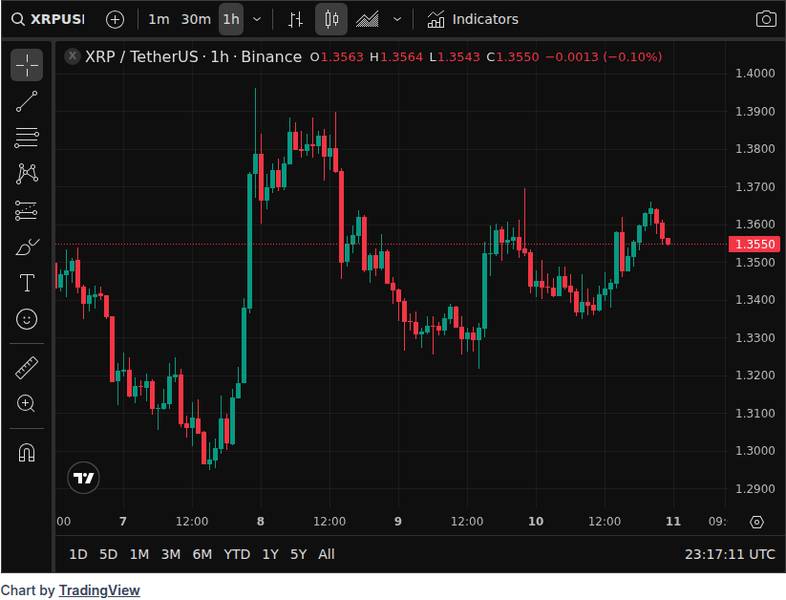
What Market Metrics Say About XRP's Recovery Signals
Price rebounds and liquidity recoveries are not the same thing. XRP's price has climbed off its October lows, but the order-book depth that supports stable trading has not followed.
Kaiko's research provides important nuance. The firm noted that XRP and SOL have the highest average 1% market depth on its vetted exchanges, and that XRP's depth has soared since late 2024, flipping SOL and doubling ADA in relative terms.
This creates a paradox: XRP can be the most liquid major altcoin in relative terms while still sitting well below its own pre-crash absolute levels. The October event reset the baseline for the entire market, and even the strongest relative performers have not clawed back to where they were.
For traders watching XRP's price structure and upcoming catalysts, the gap between price recovery and depth recovery is a warning sign. Thin books mean that any sharp move, up or down, will produce outsized slippage.
The market-wide Fear & Greed Index at 16 reinforces this picture. Extreme Fear readings correlate with reduced market-making activity, as professional liquidity providers pull back during periods of elevated volatility risk.
Why Weak XRP Liquidity Still Matters
Shallow liquidity amplifies volatility. When 1% depth is thin, a relatively small market order can push the price further than it would in a deep book, triggering cascading liquidations similar to what happened in October.
This is especially relevant given the regulatory backdrop. Kaiko's April 2026 research ties XRP's spot-market depth directly to the viability of prospective U.S. crypto ETF products under incoming SEC Chair Paul Atkins. Deep spot markets are a prerequisite for efficient ETF arbitrage, and the current depth shortfall could complicate those timelines.
The connection between XRP Ledger market integrity and institutional product readiness is becoming harder to ignore. If liquidity providers remain on the sidelines, the gap between XRP's relative strength among altcoins and the absolute depth required for ETF-grade markets will persist.
One unresolved tension in the data deserves attention. U.Today frames XRP's post-crash liquidity as bearish, while Kaiko's primary research emphasizes XRP's strong relative positioning. According to the available evidence, both can be true simultaneously: XRP leads altcoin peers in vetted exchange depth, but the entire market's absolute liquidity ceiling dropped after October and has not returned.
For a genuine recovery signal, traders should watch for 1% depth on vetted exchanges returning to or exceeding pre-October levels, not just price stabilization. Until order books refill, XRP's market structure remains fragile, even if its relative standing among altcoins like SOL and ADA looks comparatively strong.
Disclaimer: This article is for informational purposes only and does not constitute financial or investment advice. Cryptocurrency and digital asset markets carry significant risk. Always do your own research before making decisions.
Bitcoininfonews first published the article titled XRP Liquidity Fails to Recover After October Crash.
